

Yes, I can start a business at 21 without a big pile of cash. In many cases, I can launch with $500 to $5,000, and some service or freelance ideas can start for under $100. The simplest path is to pick a low-cost idea, check that people will pay, set up the business the right way, track cash, and only borrow when sales can support it.
Here’s the short version:
- Pick a low-cost model first. Service work, freelancing, and small online selling are the main paths.
- Test demand before I spend. A few paid bookings matter more than people saying “sounds good.”
- Set up the business cleanly. That means choosing between a sole proprietorship or single-member LLC, getting an EIN, and checking local license rules.
- Open a business bank account right away. I should keep all business money separate from personal money.
- Build a one-page plan and a 90-day cash-flow forecast. Revenue alone is not enough; I need to know when cash comes in and goes out.
- Get funding-ready before I borrow. Clean records, decent personal credit, and a clear use of funds matter.
- Start with one offer and one sales channel. Then I can put 30%–50% of early net profit back into growth and keep a 3–6 month cash buffer.
A few numbers stand out:
- U.S. microbusiness median startup cost: about $3,000
- SBA Microloan range: $500 to $50,000
- SBA Microloan term: up to 6 years
- Common LLC filing cost: $50 to $500
- Local service startup range: $100 to $500
If I want the best shot at getting started fast, I’d keep it lean, stay organized, and focus on first sales before I think about scaling.
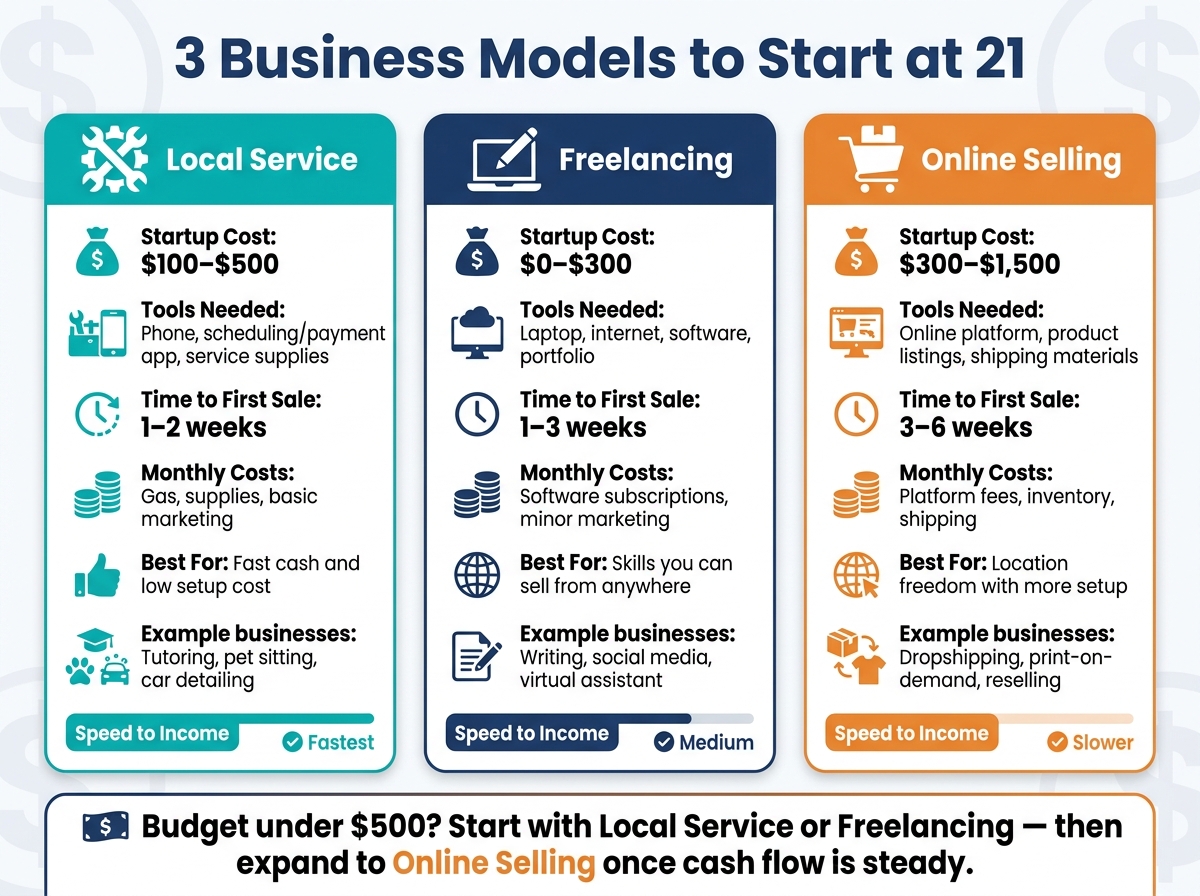
3 Business Models for 21-Year-Olds: Cost, Time & Tools Compared
13 lessons I’ve learned after starting a business at 21
sbb-itb-1eb586e
Quick Comparison
| Path | Startup cost | Time to first sale | Best for |
|---|---|---|---|
| Local service | $100–$500 | 1–2 weeks | Fast cash and low setup cost |
| Freelancing | $0–$300 | 1–3 weeks | Skills I can sell from a laptop |
| Online selling | $300–$1,500 | 3–6 weeks | More location freedom, but more setup |
The core idea is simple: start small, keep records clean, watch cash flow, and borrow for growth, not guesswork.
1. Choose a low-cost business idea you can start now
Match your skills, time, and budget to one business model
Start with one business you can test fast, not one that just looks good in a spreadsheet. The best pick is usually the lowest-cost idea that fits your skills, your schedule, and the money you can spend right now.
If your startup budget is $100–$1,000, service work or freelancing is often the best place to begin. Tutoring, virtual assistance, pet sitting, and car detailing all need little cash and can bring in money fast.
If you know a school subject well, tutoring can get off the ground for under $100 in materials. If you’re organized and fine with email and calendars, virtual assistant work may need nothing more than a laptop. Car detailing usually costs $150–$400 for supplies and can start bringing in income within days or weeks. Pet sitting and dog walking can cost even less.
The main thing is fit. A business has to work with your life as it exists now, not the life you hope to have six months from now. If you’re in college or working a day job, evening tutoring or freelance work you can do on your own time makes a lot more sense than something that locks you into daytime hours.
Test the idea before you spend any money
Before you spend a dollar, make sure real people will pay for what you’re offering. Write your offer in one clear sentence. Then share it with 5 to 10 people you already know or can reach easily, like classmates, neighbors, coworkers, or local online community groups.
Center the conversation on three questions:
- What problem are you dealing with right now?
- How are you handling it today?
- What would you honestly be willing to pay for help?
Interest feels good, but payment tells the truth. A few confirmed bookings, a small batch of pre-orders, or three paid sessions scheduled for next week tells you a lot more than a bunch of people saying, "that sounds cool." Get that proof first. Then spend on supplies, branding, or a platform subscription.
Once people are ready to buy, you can move to legal setup and banking.
Compare startup cost, tools, and time to first sale by business type
Use this table to find the fastest and cheapest path to your first sale.
| Business type | Typical startup budget | Basic tools needed | Time to first sale | Typical monthly costs |
|---|---|---|---|---|
| Local service (tutoring, pet sitting, car detailing) | $100–$500 | Phone, scheduling/payment app, service supplies | 1–2 weeks | Gas, supplies, basic marketing |
| Freelancing (writing, social media, virtual assistant) | $0–$300 | Laptop, internet, relevant software, portfolio | 1–3 weeks | Software subscriptions, minor marketing |
| Online selling (dropshipping, print-on-demand, reselling) | $300–$1,500 | Online platform, product listings, shipping materials | 3–6 weeks | Platform fees, inventory reorders, shipping |
For speed and low cost, local service and freelancing usually come out ahead. Online selling gives you more freedom in where you work, but it often takes longer to land that first sale. It also brings more upfront risk if inventory sits there and doesn’t move.
If you need income soon and your limit is under $500, start with a service or freelance model. Then circle back to online selling later, once you have some cash flow and room to test it without putting yourself in a tight spot.
2. Register your business and open a business bank account
Once you’ve checked that people will pay for what you’re selling, it’s time to make the business official. This doesn’t need to turn into a maze of forms and jargon. But the sequence matters. Skip steps now, and you may end up cleaning up a mess later.
Sole proprietorship vs. single-member LLC: which one fits you
For most first-time founders, the two main options are a sole proprietorship and a single-member LLC.
A sole proprietorship is the default setup. If you start doing business and never file anything with the state, that’s usually what you are. It’s cheap, simple, and easy to maintain. The tradeoff is serious: you and the business are legally the same person. If the business gets sued or can’t pay what it owes, your personal savings, car, and other assets may be on the line.
A single-member LLC creates a separate legal entity. In most cases, that helps protect your personal assets from business debts and lawsuits, as long as you keep business and personal money separate and follow the basic rules. So the choice is pretty straightforward: a sole proprietorship is easier and cheaper, while a single-member LLC gives you added legal protection in exchange for a state filing fee and a bit more paperwork.
| Factor | Sole Proprietorship | Single-Member LLC |
|---|---|---|
| Liability protection | None – personal assets fully exposed | Limited – personal assets generally shielded |
| Tax filing basics | Schedule C, Form 1040; self-employment tax | Same by default; can later elect S-corp status |
| Typical state formation cost | Usually $0 | Typically $50–$500 in state filing fees |
| Opening a business bank account | DBA certificate and SSN are often enough | Articles of Organization, EIN, and ID are usually required |
If you want the lowest upfront cost and the least admin work, a sole proprietorship may be enough at the start. If you want more separation between you and the business, an LLC often makes sense.
Register the business, get an EIN, and check local permit requirements
The setup process works best in a simple order.
Start by choosing a business name and checking that it’s available in your state through the state’s name search tool. If you’re forming an LLC, the name will usually need to include "LLC" or "Limited Liability Company."
Then file your Articles of Organization with your state’s Secretary of State office and pay the filing fee.
After that, apply for a free EIN at irs.gov. Save the confirmation number because you’ll likely need it for banking and taxes. The IRS is very clear that this service is free, so steer clear of third-party websites that try to charge for it.
Before you launch, check your city and county rules for licenses and permits. Many local governments require a basic business license, even for online or home-based businesses. Fees often range from under $50 to a few hundred dollars per year. If your business deals with food, transportation, childcare, or health services, you may also need extra permits or inspections.
Open a business checking account and keep records from day one
Once you have your EIN and formation documents, open your business bank account before you make your first sale. That separate account does two jobs at once: it keeps tax records cleaner, and it helps protect your liability shield.
What the bank asks for depends on your setup:
- Sole proprietor: government-issued ID, your SSN or EIN, and a DBA certificate if you’re using a trade name
- LLC: Articles of Organization, EIN, and a photo ID
It’s smart to pull everything together before you go. A little prep can save you from making two trips for no reason.
From day one, run all business income and expenses through that account. Save digital copies of receipts and invoices. Keep your formation documents, EIN confirmation, and bank statements in one folder, sorted by year and category. Clean records make tax time far less painful, and they also help if you apply for funding later, including an SBA microloan.
With your legal setup and bank account ready, you can move on to building a simple budget and a 90-day cash-flow forecast.
3. Write a simple business plan and a 90-day cash-flow forecast
Now it’s time to turn your setup into an actual budget. The SBA recommends starting with financial projections and being extra specific in year one.
Write a one-page business plan with clear pricing and sales goals
For a first business, a one-page plan should answer five simple questions:
- What do you sell?
- Who buys it?
- How will you reach them?
- What do you charge?
- How many sales do you need in month one?
Keep your answers short and concrete. No fluff.
For example, a mobile car detailing business might write: Basic detail: $60 per car; Premium detail: $90. Target customers: college students and young professionals in [city]. Main marketing channel: Instagram and local Facebook groups. Month 1 goal: 20 jobs at $60 = $1,200 in revenue.
That’s clear. You can act on it.
Your pricing should match two things: your costs and what your target customers can actually pay. If the price looks good on paper but scares people off, it won’t help much.
When you set your first-month sales goal, start with your available hours, not hope. If you have 15 hours a week and each job takes about 1.5 hours, you can handle around 10 jobs per week. But most new businesses don’t hit full capacity right away. A month-one target of 50% to 70% of that capacity is a solid place to start.
That one-page plan becomes the baseline for your forecast.
Estimate your startup costs and monthly operating expenses
Split your numbers into startup costs and monthly expenses. The ranges below are broad planning estimates for lean startups like freelancing, online stores, and mobile services.
| Cost Category | Est. Range (USD) | One-Time or Monthly |
|---|---|---|
| LLC filing & licenses | $70 – $400 | One-time |
| Basic equipment/tools | $300 – $2,000 | One-time |
| Website & domain | $50 – $300 | Mostly one-time |
| Software subscriptions | $10 – $100/mo | Monthly |
| Marketing/ads | $50 – $200/mo | Monthly |
| Insurance | $25 – $75/mo | Monthly |
| Fuel/transportation | $50 – $200/mo | Monthly |
| Inventory/supplies | $100 – $500/mo | Monthly |
This part matters because a lot of first-time owners focus on sales and forget the drip-drip-drip of monthly costs. Software, gas, supplies, and ads can eat into cash fast.
Track cash in, cash out, and your break-even point
For each of your first three months, track four numbers:
- Opening cash
- Cash in
- Cash out
- Ending cash
Here’s how that can look for a small mobile detailing startup: Month 1 opens with $800, brings in $1,200 in sales, spends $1,000, and ends with $1,000. Month 2 opens with $1,000, earns $1,800, spends $1,200, and ends with $1,600. Month 3 opens with $1,600, earns $2,400, spends $1,500, and ends with $2,500. That gives you a simple view of whether your sales are covering your bills.
You also need your break-even point. That’s the number of sales per month needed to cover your costs. The formula is simple: divide monthly fixed expenses by your profit per sale, which is your price minus your variable cost.
If your fixed expenses are $600 per month, your price per job is $60, and your variable cost per job is $15, you break even at about 14 jobs per month. After that, each extra job adds profit.
Use monthly projections through year one and update a rolling 3-month forecast every month. A spreadsheet is enough. Just keep it current.
These numbers show whether you can fund growth safely before you borrow.
4. Build credit and get ready for startup funding
Once your forecast is in place, the next step is getting lender-ready. That usually comes down to three things: your credit, your records, and a simple plan for how you’ll use the money. Lenders look at both cash flow and credit, so this is where loan prep starts.
Start building business credit and keep your personal credit in good shape
For a new business, personal credit still carries a lot of weight. Most lenders lean on it because early-stage companies don’t have much borrowing history yet.
A few habits go a long way here. Pay every bill on time. Keep credit card balances below 30% of your limit. Leave a cash cushion in your business bank account. And steer clear of overdrafts. Those small signals can shape how a lender sees risk.
You should also start building a business credit file. Get a D-U-N-S number, then open a business credit card or vendor account that reports to commercial bureaus. It’s a simple move, but it helps your business start building its own track record instead of leaning only on your personal profile.
Get loan-ready with clean records and a clear use of funds
After your credit and banking look steady, pull together the paperwork lenders usually ask for. In most cases, that means your ID, EIN letter, formation papers, and recent business statements.
If you have tax returns, include them. If you don’t, a year-to-date profit-and-loss statement based on your records can work well for a new business.
At this point, your job is to make the file easy to review. A lender shouldn’t have to guess who you are, how the business is set up, or what the funds will cover. The clearer you are, the smoother this part tends to go.
With those records ready, you’ll be in a better position to figure out which startup funding source makes the most sense.
5. Launch, make your first sales, and plan your next funding step
Start with one offer and one marketing channel
With your records in order and your funding prep done, the next step is pretty simple: choose one thing to sell and one way to reach buyers. Not two offers. Not three platforms. Just one of each.
If you run a service business like lawn care or house cleaning, that could mean posting in a local community group and asking people you know for referrals. If you’re freelancing, it might be a Fiverr profile or LinkedIn outreach to small businesses nearby. If you’re starting an online store, one Etsy listing or one Instagram page is enough to get moving. Early on, the goal isn’t to build a perfect brand. It’s to land a few paying customers.
Track every sale in a simple spreadsheet. Include the source, the offer, and the price. That way, you can see which channel is doing the job instead of guessing. When one path starts bringing in buyers, put more energy there.
Reinvest early revenue and avoid buying too much too soon
Once money starts coming in, it’s easy to feel like you should upgrade everything at once. Try not to. Early spending on premium branding, equipment you don’t use, or inventory you haven’t tested can eat through cash fast.
A better move is to put 30–50% of early net profit back into things that can bring in more sales. That could mean:
- Restocking inventory that’s already selling
- Putting a modest ad budget behind a channel that’s already converting
- Paying for a tool that helps you deliver your service faster
At the same time, keep a 3–6 month cash buffer for slow weeks and surprise costs.
Conclusion: Start lean, stay organized, and borrow only for growth
Starting a business at 21 doesn’t take a huge budget or perfect credit. It takes a low-cost idea, proof that people want it, a registered business, a separate bank account, a one-page plan, and a simple habit of tracking money in and money out. Those basics, done over and over, put you ahead of most first-time owners.
Once sales begin, match your next funding source to the exact expense you need to cover. Borrow only for costs that can help bring in revenue. Use savings for launch costs, microloans for working capital, and equipment financing for tools that directly support sales.
When you’re ready to grow past what your own savings can cover, the SBA Microloan program requirements can offer up to $50,000 for working capital, inventory, supplies, and equipment. Average loan sizes are around $13,000–$16,000.
FAQs
Do I need an LLC right away?
Not always. You can apply as a sole proprietor or freelancer, and the SBA Microloan program works with more than one business setup.
That said, many lenders want to see a formal business structure.
If you set up an LLC, they may ask for:
- Articles of Organization
- An operating agreement
If you stay a sole proprietor, they may ask for:
- A business license
- A DBA if you use a trade name
How do I know if my idea will actually sell?
Move past gut feeling and do market research.
Start by defining your target market, the problem your product or service solves, and what competitors are doing. It also helps to look at industry trends so you can see where the market is heading, not just where it is today.
Then validate demand with a simple business plan, realistic revenue projections, and month-by-month cash-flow forecasts for your first year. Think of it as a reality check on paper. If the numbers don’t hold up there, they probably won’t hold up once money starts going out the door.
Back up your estimates with data, not hope, and get feedback from mentors or advisors before you invest major time or money.
When should I use a loan to grow?
Use a loan to grow when you have a clear, documented business need that should directly support revenue or day-to-day stability.
A loan can help pay for startup costs like equipment, inventory, supplies, or furniture. It can also give you working capital for payroll, rent, or marketing.
The key is simple: borrow only when your business plan and cash-flow projections show a clear path to repayment through projected growth. If the numbers don’t support it, taking on debt can put pressure on the business before it has room to grow.
Leave a Reply