
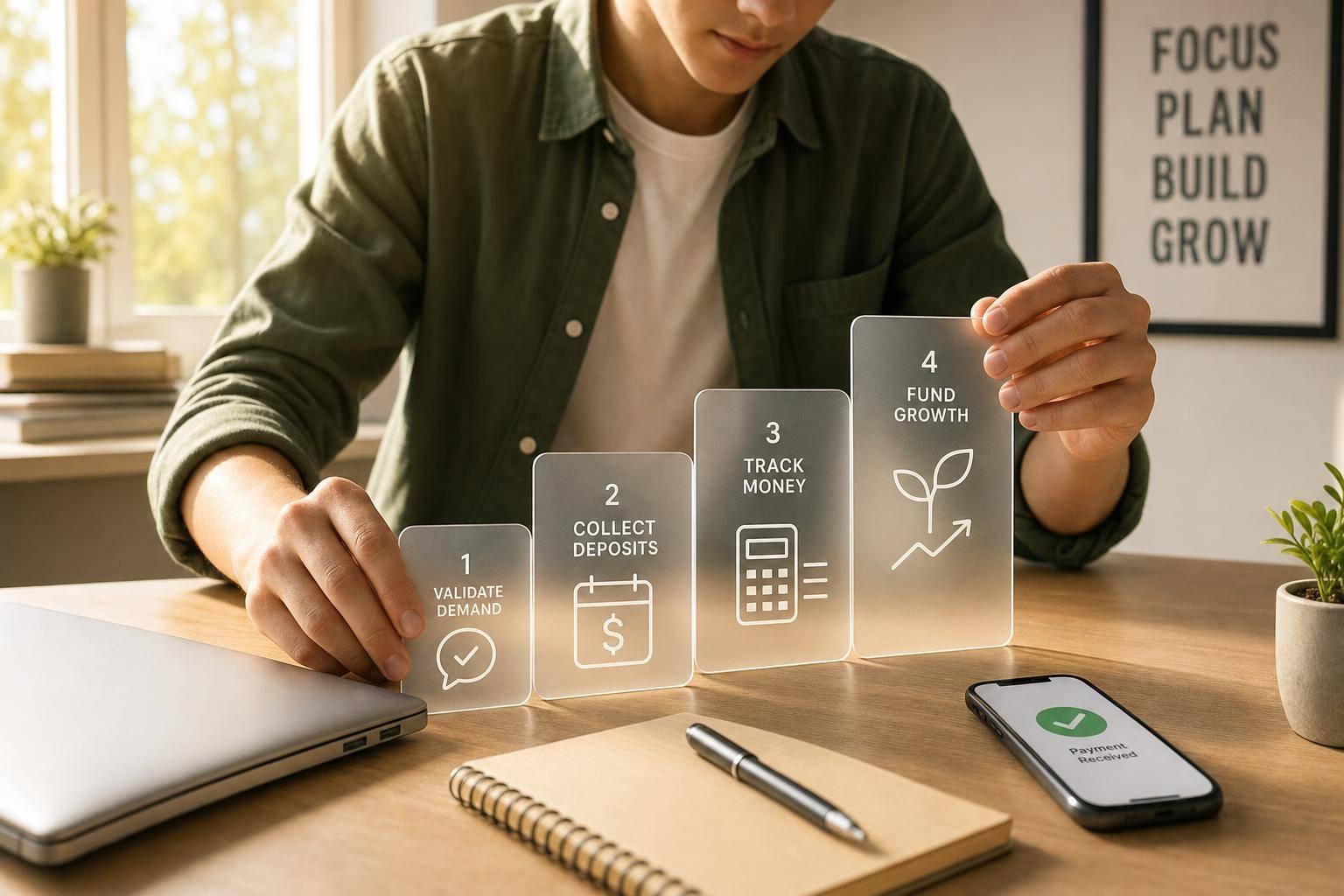
Yes, I can start a business at 18 with as little as $0 to $500 – but only if I keep costs low and get paid early. The main idea is simple: I pick a low-cost service, test if people will pay, collect deposits, track every dollar, and only look at a loan after I have steady sales.
Here’s the short version:
- Start with services first. Tutoring, freelance work, cleaning, lawn care, social media help, and reselling are common low-cost options.
- Pick based on my life right now. My skills, free time, and transportation matter more than picking the “best” idea on paper.
- Do not spend first and hope later. I should test demand by talking to 10–15 people and making one clear offer.
- Ask for a deposit. A 25%–50% upfront payment can help cover supplies before I spend my own cash.
- Keep setup simple. A Google Form, Canva, a spreadsheet, and a payment app are often enough to start.
- Handle the basics after first sales. That usually means sole proprietorship rules, maybe a DBA, a separate bank account, and tax tracking.
- Save part of each payment. Setting aside 20%–30% for taxes can help me avoid trouble later.
- Use small funding first. Personal savings, part-time job income, pre-sales, and written family loans come before outside borrowing.
- Think about an SBA microloan later. These can go up to $50,000, but they make more sense after I have a few months of sales and clean records.
A few numbers stand out. About 33% of U.S. small businesses start with less than $5,000, and many small home or service businesses start with much less. Also, 75% of new businesses use personal savings at the start. That tells me I do not need a big pile of money to begin. I need proof that people will pay.
What I Wish I Knew Before Starting a Business at 18
sbb-itb-1eb586e
Quick Comparison
| Business type | Usual startup cost | Time to first sale | Best if | Permit risk |
|---|---|---|---|---|
| Tutoring | Under $100 | 1–4 weeks | I’m good at a school subject | Low |
| Freelancing | $100–$200 | 1–2 weeks | I can write, design, or edit | Low |
| Cleaning | $200–$300 | 1–2 weeks | I can travel locally | Medium |
| Lawn care | $200–$400 | 1–2 weeks | I have access to gear and a ride | Medium |
| Social media help | Under $100 | 2–4 weeks | I know Instagram, TikTok, or Canva | Low |
| Reselling | $150–$400 | 2–6 weeks | I can find and ship items | Medium |
Bottom line: if I want to start at 18 with little money, I should start lean, get paid before I spend much, and build step by step. That is the path this article lays out.
Choose a Low-Cost Business You Can Launch This Month
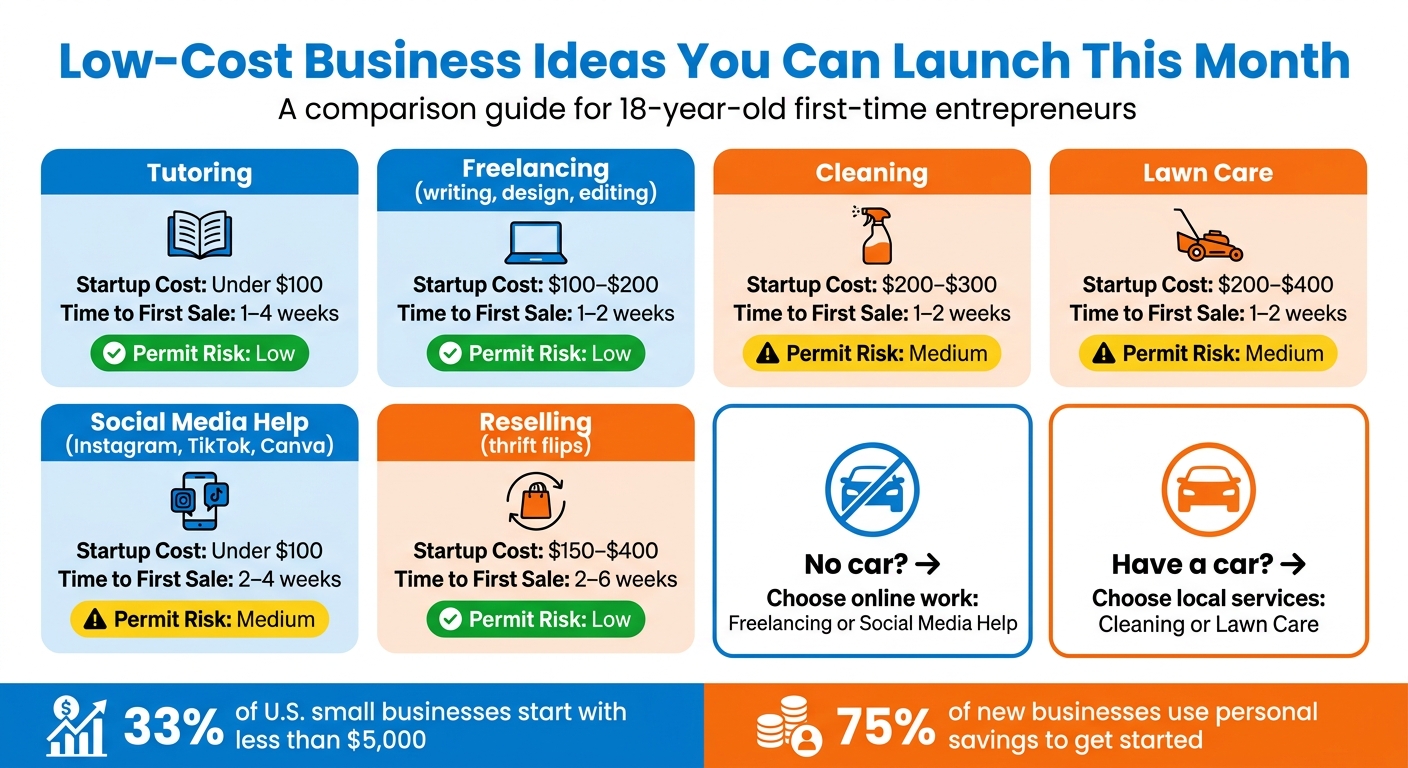
Low-Cost Business Ideas for 18-Year-Olds: Startup Costs & Time to First Sale
Start with the business that fits the life you already have, not the one that sounds coolest on paper. Your current skills, your weekly schedule, and how you get around will tell you which low-cost option makes sense right now.
Use this table to narrow things down fast:
| Business Type | Time to First Sale | Permit or license needed? |
|---|---|---|
| Freelancing (writing, design) | 1–2 weeks | Low – usually no special permits |
| Tutoring | 1–4 weeks | Low – usually no special permits |
| Cleaning & lawn care | 1–2 weeks | Medium – local business registration or license may apply |
| Reselling (thrift flips) | 2–6 weeks | Medium – check local reselling and sales tax rules |
| Social media services | 2–4 weeks | Low – usually treated as professional services |
Match Your Skills, Time, and Transportation to the Right Business Model
Pick based on three inputs: your skills, your weekly availability, and your transportation.
If you don’t have a car, online work is usually the best place to start. Freelancing and social media services are often easier to run from home, and you can begin with tools you already use. If you do have a car and can travel on time, local services like cleaning or lawn care can bring in cash faster.
Tutoring sits in a nice middle ground. You can do it online through free video platforms, and it tends to work well if you’re strong in a subject like math, science, or SAT prep. Demand often climbs near exam periods, which can make timing work in your favor.
Here’s the rule of thumb:
- Choose online work if transportation is limited.
- Choose local services if you can travel reliably.
That simple choice helps keep startup costs low enough to begin with savings, pre-sales, or family help before any loan is even on the table.
Estimate Your Startup Costs Before Spending Anything
Before you buy a single thing, write down your likely costs. That includes supplies, phone and internet, transportation, marketing, and any required registration or license fees.
At this stage, the goal is simple: spend only what you need to deliver your first job.
That means no extra gear, no fancy logo, and no pile of stuff you might need later. Get the cheapest setup that lets you do the work well, then use what you earn to pay for the next step. Once you’ve picked the lowest-cost model that still works, test demand before spending more.
Test Demand Before You Spend More Money
After you pick a low-cost idea, check demand before you buy anything. A few days of outreach can tell you if the idea is worth spending on.
Talk to Potential Customers and Test a Simple Offer
Reach out to 10–15 people in your target market and keep each chat to 5–10 minutes. That can be classmates, neighbors, parents, or local business owners.
Ask simple, direct questions. Find out when they last paid for this kind of service, how they handle it now, what they spend, and what would make them pay for it again.
When you start hearing the same things over and over, turn that into one clear offer. Keep it plain and easy to say yes to.
For example:
- A cleaner might offer a first apartment clean, up to 2 hours, for $50 to the first 5 bookings.
- A tutor might offer a free 30-minute assessment plus a first 60-minute session for $20.
- A social media helper might offer 5 Instagram posts and 10 story templates for $75 in one week.
The goal isn’t just polite interest. You want a booking or a deposit.
If people say yes, collect a deposit before you spend money.
Use Free Tools to Collect Leads, Pre-Sales, or Deposits
You don’t need a website or paid software yet. A Google Form can collect names, contact info, service choice, and preferred dates. You can share it by text or social media, make the offer in Canva, and track replies in a spreadsheet or Notion.
Collect a 25%–50% deposit through a payment app before you buy supplies. Set a simple target, like 5 paying clients or $300 in pre-sales. If nobody pays, that’s useful information. Change the offer, price, or audience before putting in more money.
Once demand is proven, move to basic registration, banking, and recordkeeping.
Set Up the Basics: Registration, Banking, and Money Tracking
After your first sales or deposits, take care of registration, banking, and recordkeeping before you grow. Once money starts coming in, you’re no longer just testing an idea. You’re running a business, and the basics matter.
Start With a Sole Proprietorship and Check Your Local Requirements
A one-person business usually starts as a sole proprietorship, but you should check local filing rules before you operate.
If you plan to use a business name, register a DBA with your county or state. After that, look into city and county rules for a business license or home occupation permit.
You can usually wait on forming an LLC unless your business risk or income starts to justify the extra cost.
Once you’ve handled those first steps, separate your money right away and track every sale.
Open a Business Bank Account and Track Every Dollar
Open a separate business checking account as soon as you collect money. Mixing personal and business funds makes taxes harder and makes it tough to see what you’re actually earning. As a sole proprietor, you will usually need:
- A government-issued photo ID
- Your Social Security Number or an EIN, if you want to use one
- Your DBA certificate, if the account will be in your business name
For tracking, a simple Google Sheets spreadsheet is enough at the start. Log every payment and expense with the date, amount, and category. Focus on a few key buckets: client payments, supplies, transportation, and marketing. Set aside 20% to 30% of each payment for taxes.
Then review your profit each month. If too little is left after expenses, it’s probably time to charge more.
Lenders want clean records and a clear picture of your costs. Good records also make a later microloan review easier and faster. These records become the base for small funding later.
Fund Your First Stage and Build Toward Microloan Readiness
Use Small Funding Sources First to Avoid Overborrowing
After your first sales come in and your records are in order, start with money you already control. One SBA Office of Advocacy FAQ says 75% of new businesses use personal savings to get started, and a national survey found 27.6% rely on income from another job during their first year.
A simple way to think about it: build in layers.
Start with whatever savings you have. Even $50–$200 can cover basic supplies for a cleaning or lawn care job. Then add income from part-time work or gig work. After that, use deposits or prepayments from your first customers. If you sell five tutoring packages at $200 each, that gives you $1,000 up front before you spend anything on marketing.
If family support is on the table, treat it like a business deal. Put the loan terms in writing, including the amount, repayment schedule, and due dates. That keeps things clear and helps avoid stress later.
The point is simple: fund only what you need for the first few jobs. Once those sources can carry the early work, you’re in a better spot to get loan-ready.
| Funding Source | Typical Amount (USD) | Repayment Requirement | Documentation Needed | Best Use Stage |
|---|---|---|---|---|
| Personal savings | ~$50–$500 | None | Personal budget tracking | Very early: testing ideas, initial supplies |
| Pre-sales/deposits | ~$100–$1,000+ | Must deliver service or refund | Basic order records and agreements | Early stage once customers show interest |
| Family support | ~$100–$2,000 | Per written agreement | Simple signed loan document | Early to growth stage for essentials |
| SBA microloans | Up to $50,000 | Monthly payments up to 6 years | Business plan, use-of-funds, cash flow, ID, financial records | Growth stage after steady demand |
Get Ready for an SBA Microloan Once Your Business Has Steady Demand
Once you have steady paying customers, a few months of revenue history, and a clear reason to borrow, an SBA microloan becomes a practical next move. These loans go up to $50,000 through SBA-approved nonprofit intermediary lenders, and average loan sizes often land around $13,000–$16,000.
You can use the funds for working capital, inventory, supplies, equipment, and fixtures. In most cases, you can’t use them for real estate purchases or to refinance existing debt.
To get ready, pull together a short set of documents:
- A simple business plan that explains your model, target customers, and pricing
- A use-of-funds breakdown that shows exactly where the money will go
- Basic 12-month cash-flow estimates
- A valid photo ID
- The financial records you’ve already been keeping, like bank statements, invoices, and your expense log
Six months of clean records can help your application look stronger and can make the lender’s review move faster.
Conclusion: Start Lean, Prove Demand, and Fund Growth in Stages
Start with demand, not debt. A low-cost idea, a few paying customers, clean records, and careful spending can carry you through the first stage. Personal savings, pre-sales, part-time income, and written family support can cover the early work. Then, once demand is steady and you know exactly why you need outside capital, SBA microloans become a solid next option.
Early traction and organized finances don’t just help you run the business day to day. They’re often the difference between a lender passing and a lender saying yes.
FAQs
What business should I start first?
Start with a business that matches your skills, has low overhead, and serves a clear market need. If you’re 18 and short on cash, service businesses are often the best place to begin.
Why? Because they don’t need much money upfront, and you can get going with skills you already have.
Good examples include:
- Freelancing
- Tutoring
- Reselling
- Cleaning
- Lawn care
- Social media management
Before you launch, make sure people actually want what you’re offering. Validate demand first. Then put together a simple plan for how you’ll solve one specific problem.
That part matters. A business usually gets traction when it’s clear, focused, and easy to understand.
Keep your costs low from day one, and skip expenses you don’t need.
How do I know if people will pay?
Validate demand by researching your target audience and making realistic sales projections. A solid business plan helps you pin down who your customers are, spot where the market is headed, and check whether your idea solves a real problem.
You can also test interest with pre-sales. They can give you early proof that people want what you’re offering and bring in some early cash flow at the same time. This kind of research also shows lenders that you know your market.
When should I apply for a microloan?
Apply for an SBA microloan when you need a smaller amount for specific startup costs, like initial inventory, basic equipment, working capital, or business licenses, and you have a clear plan for how that money will help bring in revenue.
Before you apply, get your paperwork in order. That means having a polished business plan, solid financial projections, and records that support your expected expenses. Lenders want to see that you know where the money will go and how you plan to pay the loan back.
Leave a Reply