

If I want an SBA microloan, I should expect lenders to focus on five things: how I’ll use the money, who will run the business, whether cash flow covers the payment, what my credit shows, and how I’ll repay the loan.
SBA microloans go up to $50,000. They can be used for things like working capital, inventory, supplies, furniture, fixtures, machinery, and equipment. They can’t be used for real estate or debt payoff/refinancing. These funds are also a popular SBA micro loan for women entrepreneurs looking to launch or grow a small business. So before I apply, I need to show:
- a line-item budget for the full loan amount
- a plain-English view of ownership and day-to-day management
- a 12-month cash flow forecast with the new payment included
- support for my numbers, like quotes, bank statements, tax returns, and P&L reports
- short written notes for any late payments, collections, defaults, or bankruptcy
Lenders also want to know if the payment fits my business. In many cases, they look for cash flow that is about 1.15x to 1.25x the monthly debt payment. So if the loan payment is $1,000, they may want to see about $1,150 to $1,250 left after business costs.
Here’s the short version: I improve my odds when I ask for an amount my business can support, keep the use of funds within SBA rules, and bring documents that match my story.
| Question | What I should be ready to show |
|---|---|
| How will I use the loan? | Line-item budget, quotes, invoices, cost estimates |
| Who will run the business? | Work history, owner roles, ownership % |
| Can cash flow cover payments? | Monthly revenue, expenses, slow-season plan, 12-month forecast |
| What does my credit show? | Explanations for credit issues, debt summary |
| How will I repay it? | Tax returns, bank statements, P&L, balance sheet, payment plan |
That’s what this article gets into: the exact questions lenders ask and what I should have ready before the review starts.
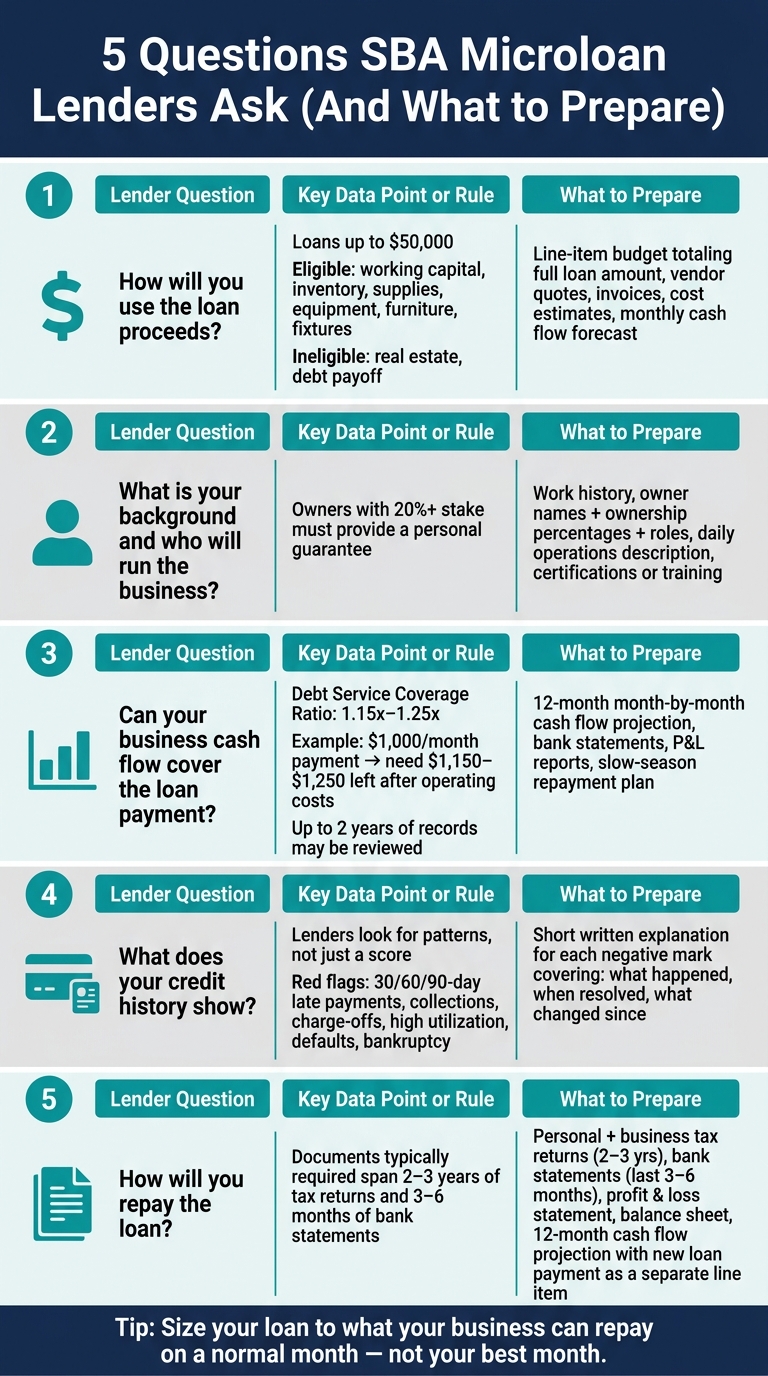
5 SBA Microloan Lender Questions: What to Prepare
REAL SBA Application Review #1: Approval Odds, Red Flags, & Recommendations
sbb-itb-1eb586e
1. How will you use the loan proceeds?
Answer with a line-item budget that adds up to the full loan amount you’re asking for. That’s the starting point. From there, lenders decide whether each expense makes sense for where your business is right now.
What lenders look for in your use-of-funds answer
Lenders want more than math that checks out. They want to see that the loan request matches your stage of business and that each item ties back to sales or day-to-day operations.
Every line item needs a clear business reason. Equipment may help you handle more jobs. Inventory may support sales of products that move fast. Working capital should cover specific costs like payroll, rent, and utilities for a set time period. If you’re a startup, focus on launch costs. If you already have an operating business, show whether the money will help with growth, stability, or seasonal cash flow needs.
Back up your numbers with vendor quotes, invoices, or cost estimates. If part of the loan will go toward working capital, include a monthly cash flow forecast that shows how the funds will cover expenses until sales increase.
Approved uses vs. disallowed uses
SBA microloan funds can only be used for eligible business purposes under SBA rules. Some common ineligible uses are:
- Personal expenses or personal debt
- Speculative investments
- Past-due payroll, sales, or other trust-fund taxes
If your business has current debt or you’re dealing with personal money pressure, handle that in the credit and repayment section instead. Don’t place ineligible items in the use-of-funds section, even if they feel urgent.
After the use-of-funds plan, lenders want to know who will manage the business.
2. What is your background and who will run the business?
Once your use-of-funds plan is clear, lenders turn to the people behind the business. They want to know one simple thing: can this owner or team carry out the plan? If you’re a startup or a first-time borrower, expect a closer look. There isn’t much operating history to review, so the focus lands on you. After that, lenders move to the next issue: whether the business will bring in enough cash to repay the loan.
Industry experience, ownership structure, and daily management
Lenders usually focus on three areas: your work history, how the business is owned, and who runs day-to-day operations.
They want to see experience that fits the business. That could mean direct industry work, nearby roles, or skills that carry over well, like budgeting, managing employees, or dealing with vendors. You don’t need a perfect résumé. But you do need to make the match clear.
Spell out each owner by name, ownership percentage, and role. Also note that anyone with 20% or more will usually need to provide a personal guarantee. If you’re a sole proprietor, say it plainly: you own 100% of the business and handle all operations. If it’s a partnership, keep it simple. For example:
"Owner A (60%) manages operations and hiring; Owner B (40%) handles finances and marketing."
This part should be concrete. Vague claims don’t help much. Lenders want to picture how the business runs on a normal week. Explain your schedule in plain English: what time you open, who you oversee, how you handle bookkeeping, and which tools you use, such as accounting software, a point-of-sale system, or a scheduling app. Think of it this way: if someone read this section alone, could they tell who is steering the ship each day?
How to address limited experience
A short track record doesn’t automatically knock you out. Lenders are judging whether you can run the business, not whether you’ve spent decades in the field.
If your direct experience is limited, use the proof you do have. That might include training programs, certifications, vendor ties, or a mentor with industry know-how. Intermediary lenders often require borrowers to take part in training as a loan condition, so getting into those programs early can help your case. You can also name advisors or seasoned partners in your management section to show that weak spots are covered.
The goal here is simple: show that the business is in capable hands, even if your background is still growing.
After the management team, the next question is whether the business can make the payment.
3. Can your business cash flow cover the loan payment?
After management, lenders usually move to a pretty direct question: can your business make the loan payment out of normal monthly cash flow? They don’t expect perfect profits on day one. What they do want is clear proof that the business brings in enough money to handle the debt.
Revenue, expenses, and busy and slow months
Lenders line up your expected monthly revenue against your recurring costs. That usually includes rent, payroll, inventory, utilities, insurance, and any debt you already pay. They want to see money left over after those operating costs so the business can cover the new loan payment and still have some breathing room.
A common way they check this is by comparing cash available for debt payments to the payment itself. A ratio of about 1.15 to 1.25 or more is common. Put simply, if your monthly debt payments are $1,000, lenders often want to see around $1,150 to $1,250 left after operating costs.
For seasonal businesses, this matters even more. Lenders usually want to see the full year, not just your strongest stretch. That means month-by-month projections that show both busy periods and slower ones. Use bank statements and P&L reports to back up the pattern. In some cases, lenders may look at up to two years of records.
Slow months can’t be brushed aside. Those months still need to show enough cash to cover debt payments. If the business depends on a few strong months, spell out how you’ll set money aside during those peaks so you can get through the quieter periods without falling behind.
Why the loan amount must match repayment capacity
Asking for more than your cash flow can handle can work against you. Even if the planned use of funds fits SBA rules, the deal can still look shaky if the payment pushes your monthly budget too hard.
That’s why it helps to size the loan with a conservative cash flow forecast. Don’t base the request on your best month. Base it on what the business can handle on a normal month, and especially on the weaker ones.
4. What does your credit history show, and how will you repay the loan?
Once lenders look at cash flow, they usually turn to your credit history to see if it tells the same story. They’re trying to answer two basic questions: Have you handled past payments well? And can you pay this loan on time?
Credit issues lenders may ask you to explain
Lenders pull your personal credit report and look for patterns, not just a score. They often focus on red flags like 30-, 60-, or 90-day late payments, accounts in collections, charged-off debts, high credit utilization, prior defaults, and bankruptcies. A thin or limited credit file can also lead to extra questions.
Poor or limited credit does not always knock you out. Many SBA microloan intermediaries have more room to work with borrowers who have credit problems if other parts of the file are strong. That matters because lenders usually aren’t looking for a spotless record. They want a straight answer and a clear sense of what changed.
For each negative mark, write a short explanation that covers:
- What happened
- When it was resolved
- What you’ve done differently since
If an issue has been cleared up, say so plainly. Keep it simple. No long defense, no wordy backstory, just the facts.
Documents that support your repayment plan
Lenders also want to see whether your credit record lines up with your repayment plan. To show that, you’ll usually need documents like these:
| Document | What It Shows |
|---|---|
| Personal and business tax returns (2–3 years) | Verified income, expense patterns, and financial consistency |
| Recent bank statements (last 3–6 months) | Actual cash flow and deposit history |
| Profit and loss statement / balance sheet | Current business profitability and debt levels |
| 12-month cash flow projection | How the new loan payment fits into future operations |
The 12-month projection matters a lot. It should show the new loan payment and all current debt payments as separate line items. That gives the lender a clean view of how the payment fits into day-to-day operations.
What to organize before the lender review
Before your meeting, gather a summary of your current debts, a clear use-of-funds breakdown, your ownership and management details, realistic cash flow numbers, written explanations for any credit issues, and the full document package above.
Think of it like setting the table before dinner. If everything is in the right place, the conversation moves faster and with less friction. A lender can review the file, ask better questions, and get to the repayment discussion without digging through loose ends.
FAQs
What if my credit is poor or limited?
Poor or limited credit doesn’t automatically rule you out for an SBA microloan. Many SBA intermediary lenders look at the full picture, not just your credit score.
Some may look for scores in the 550 to 675 range. Others may still consider lower scores if your business looks solid and has a clear path forward. SBA50K can help you put together an SBA-compliant business plan that makes your application stronger.
How much can I realistically ask for?
Under the SBA Microloan Program, you can borrow up to $50,000. That said, most borrowers get much less – usually around $14,000 to $15,000.
The SBA sets the top limit. But the intermediary lender makes the final call based on your business plan, how you plan to use the money, and your ability to repay.
Some loans start as low as $500, and repayment terms can run for up to 6 years.
What should I prepare before applying?
Before you apply for an SBA microloan, get your paperwork in order.
You’ll usually need a professional, SBA-compliant business plan, plus financial projections or cash flow statements and personal and business financial statements.
It also helps to have the basics ready from day one:
- Your business registration
- An active bank account
- Your EIN
You should also be ready to explain your background and spell out exactly how you plan to use the funds. Lenders want to see that you’ve done your homework and know where the money is going.
SBA50K can help with a custom business plan, a funding guide, and application support.

Leave a Reply