
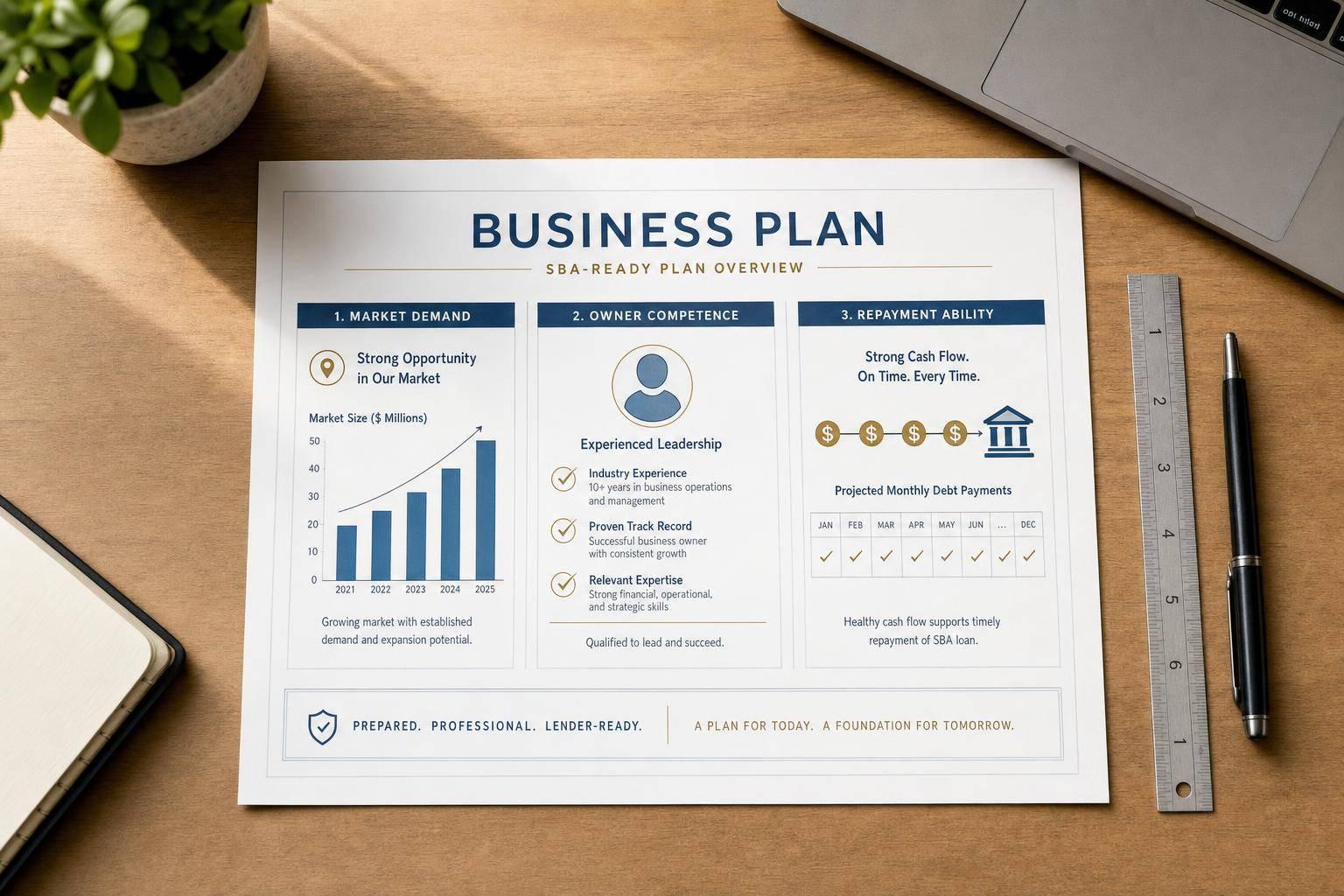
If I want an SBA microloan, my business plan has one job: show demand, show I can run the business, and show the loan gets repaid.
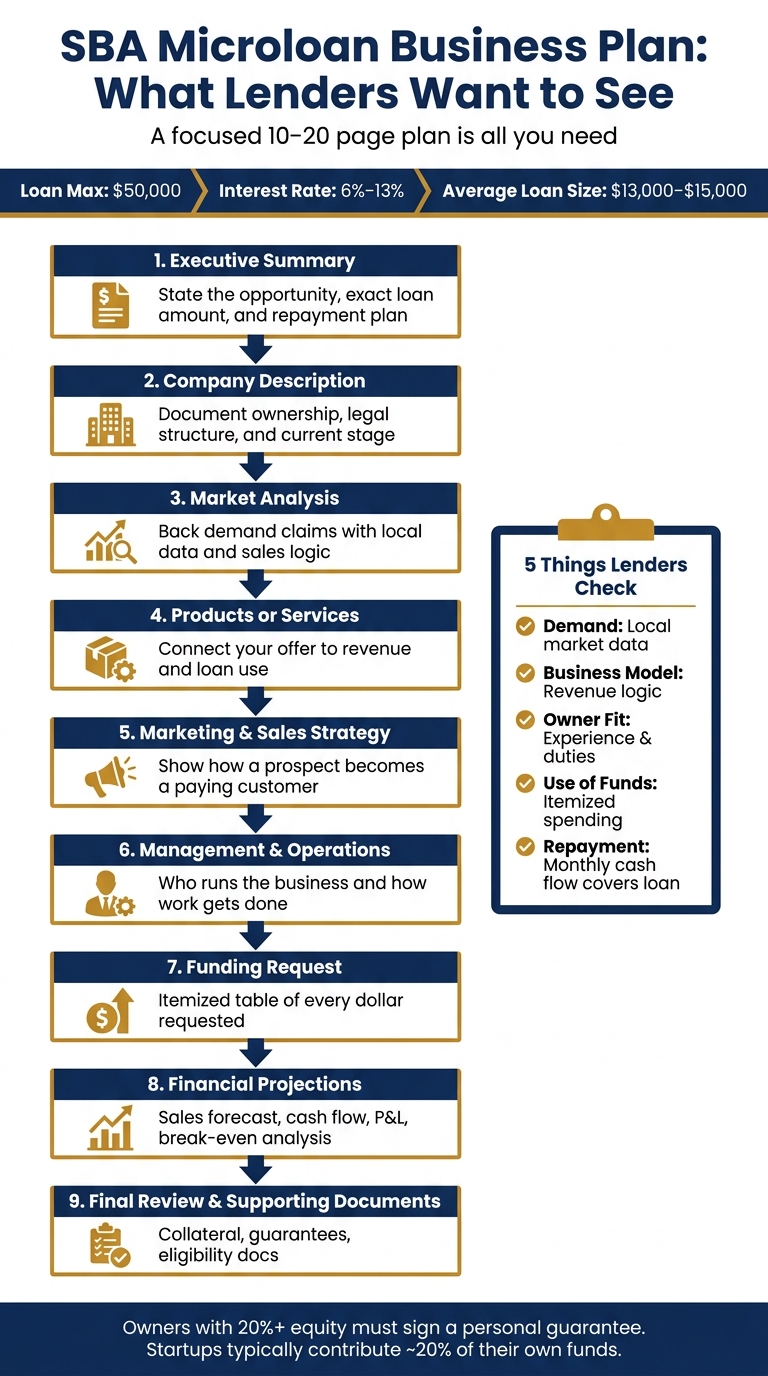
For most SBA microloan requests, I do not need a long plan. A focused 10- to 20-page plan is often enough. The SBA Microloan program offers up to $50,000, with rates often around 6% to 13%, and average loan sizes near $13,000 to $15,000.
Here’s what lenders want from me right away:
- Who I serve
- What I sell
- Why customers will buy from me
- Who runs the business
- How monthly cash flow covers the loan payment
I also need to keep each section tied together. If I ask for $18,500 for equipment and working capital, my plan should show:
- where that money goes,
- how it helps sales or output,
- and how that leads to repayment.
A strong lender-ready plan usually covers these parts:
- Executive summary
- Company description
- Market analysis
- Products or services
- Marketing and sales
- Management and day-to-day plan
- Funding request
- Financial projections
- Final review and supporting documents
The numbers matter most. Lenders want sales forecasts, cash flow, expenses, and a break-even point that all match the rest of the plan. They may also look at owner cash contribution, personal guarantees for owners with 20% or more ownership, and current business results if the company is already open.
| What lenders check | What I need to show |
|---|---|
| Demand | Local market data, customer need, and sales logic |
| Business model | What I sell and how money comes in |
| Owner fit | Experience, duties, and business setup |
| Use of funds | Clear itemized spending plan |
| Repayment | Monthly cash flow that covers the loan |
In short, I should write for the lender, not for style. Clear facts, plain numbers, and a direct repayment story are what move the plan forward.
SBA Microloan Business Plan: 9 Sections Lenders Want to See
3 "Don’ts" When Writing a Business Plan for an SBA Loan
Write the two sections lenders read first: executive summary and company description
These two sections need to do one job fast: show who owns the business, what it does, how it runs, and how the loan gets paid back.
Executive summary: state the opportunity, loan request, and repayment plan
Use the executive summary to spell out what the business does, who it serves, why you’re the right person to run it, and how much funding you need. Keep it tight, but make it specific. A lender should be able to scan this section and understand the deal in a minute or two.
Show how the loan ties to growth. Then show how that growth supports repayment. That link matters. If you’re asking for money, the lender wants to see where it goes and how it turns into cash flow.
State the exact dollar amount. For example, "We are requesting $18,500 for equipment and working capital."
| Executive Summary Component | Action |
|---|---|
| Business Overview | State name, location, and legal structure (LLC, corporation, or sole proprietorship) |
| Use of Funds | List itemized spending: inventory, supplies, furniture, fixtures, or machinery |
| Repayment Plan | Show projected cash flow covers monthly payments |
| Competitive Edge | Identify target customers and state your differentiation |
Also note any personal-guarantee requirement for owners with 20% or more ownership.
Think of this section as the lender’s first pass. Before they dig into the full plan, they want the shortest clear version of the story.
Company description: document ownership, operations, and current stage
The executive summary makes the case. The company description backs it up with facts.
Lenders use this section to confirm that the business is real, active, and set up the right way. That means you should state the legal structure, ownership split, and operating location. If the business is home-based, say so plainly. Then explain what you sell, who supplies it, and how many people are involved in running it.
This section should also match the stage of the business. If you’re a startup, you probably don’t have much operating history yet, so milestones matter. Walk through what happens by month or quarter, including when you plan to register the business and secure any needed licenses, permits, or certifications.
If the business is already up and running, lenders want current numbers instead of future plans alone. Include:
- Current monthly revenue
- Number of active customers
- Employee count
- Any equipment or accounts receivable that could serve as collateral
Stick to plain, factual language. No fluff. No big claims you can’t back up. At this point, the plan is moving from "here’s the business" to "here’s why people will buy from it and how it will make money."
Show demand and a path to revenue: market analysis, products, and marketing
Once a lender knows who you are and what your business does, the next question is blunt: will anyone buy this? That’s what these three sections need to prove. Together, your market analysis, products or services, and marketing strategy should show demand, how you’ll turn that demand into sales, and how those sales support repayment. The key is evidence – not guesswork.
Market analysis: back every major claim with evidence
Use your market analysis to show demand, define your target customer, and support your sales forecast. The aim is simple: show who you sell to, how much demand exists, and what sales you expect.
That means using local market data, past sales if you have them, and detailed financial projections if you don’t. If you’re a startup, this section matters even more. You need to show that you understand the industry’s cost structure and that demand is strong enough to support repayment.
Be direct about your competition too. Who else serves this market? What trends are shaping buyer behavior, pricing, or costs? Lenders don’t expect a perfect market. They want to see that you understand the risks and have looked at them head-on. That kind of honesty helps build trust.
Most of all, show the math. If you claim demand is there, back it up. If you project sales, explain how you got there. If repayment depends on certain margins or volume, make that easy to follow.
Once demand is clear, the next step is to show how your offer turns that demand into revenue.
Products or services: connect your offer directly to revenue and loan use
Demand alone doesn’t get a loan approved. Your offer has to match that demand in a way that brings in revenue.
Start with the customer’s problem. Then explain, in plain English, how your product or service solves it. This section should make it easy to see why someone would choose you and pay for what you sell.
After that, tie your offer straight to the loan request. List each loan-funded expense and explain what it does for the business. Does it increase capacity? Help you make more sales? Improve cash flow? Spell that out.
A lender should be able to look at each loan-funded item and understand how it affects output, margin, or sales. If your business also depends on licenses, permits, or certifications, include those here so there’s no gap between what you sell and what it takes to sell it.
Then move to the next piece: how customers will find you and why they’ll buy now.
Marketing and sales strategy: show how a prospect becomes a paying customer
Now show the path from interest to payment. Lenders want to see a repeatable sales process with numbers behind it. They also want your marketing assumptions to match your financial projections.
Be specific about your target market and the channels you’ll use to reach them, such as digital advertising or SEO. Don’t keep it high-level. Map out how a prospect becomes a lead, how that lead becomes a sale, and how you earn repeat business after the first purchase.
It also helps to explain who handles sales today and how that role will grow as the business grows. If one person closes every deal now, what happens when lead volume goes up? If repeat purchases are part of your forecast, show how you plan to drive them so the numbers support loan repayment.
This section should feel less like a pitch and more like a working system – one that shows how attention turns into revenue, and revenue turns into repayment.
sbb-itb-1eb586e
Prove the business can operate and repay: management, operations, funding, and projections
After lenders read your market and sales story, they still need answers to two basic points: can this team run the business, and will cash flow cover the loan? This part of the plan does that. Now you’re showing the people, day-to-day systems, and financial numbers behind repayment.
Management team and operations plan: show who runs the business and how work gets done
Start with short bios for each owner and key staff member. Keep the focus on background, relevant experience, and day-to-day duties. Prior industry experience matters here, especially two years or more.
Then walk through how the business will run each day. Explain your business structure, location, staffing needs, key suppliers, and how you’ll get inventory or materials. This is where lenders want to see that the business won’t run on hope alone.
If there are weak spots or operating risks, say so plainly and explain how you’ll handle them. Maybe you depend on one supplier. Maybe hiring could take time. Maybe demand is seasonal. Whatever the issue is, show the backup plan. Lenders want proof that you’ve thought through the rough patches and know how to keep things moving.
Also state whether any owner with 20% or more equity will sign a personal guarantee.
Once the team and workflow make sense, connect that plan to the loan request.
Funding request and use of funds: present an itemized table for the lender
State the full amount you’re asking for, then break it out in a table. If you’re putting in your own money, include that as well. Startups are often expected to contribute around 20%. The goal is simple: make it easy for a lender to trace where every dollar goes.
| Expense Category | Amount | Purchase Timing | Business Purpose | Expected Result |
|---|---|---|---|---|
| Machinery/Equipment | $15,000 | Month 1 | Increase production capacity | 20% higher monthly output |
| Inventory/Supplies | $10,000 | Months 1–2 | Stock for new product line | $5,000/mo. added revenue |
| Working Capital | $10,000 | Months 1–6 | Cover payroll during ramp-up | Stabilized operations |
| Furniture/Fixtures | $5,000 | Month 1 | Retail space build-out | Professional customer environment |
| Total Request | $40,000 |
Leave out real estate and debt refinancing. Both are ineligible uses.
Financial projections: build forecasts that match the rest of the plan
Your projections need to show one thing above all: monthly cash coming in can cover the monthly loan payment. For startups without past revenue, these forecasts are the main proof of repayment ability.
Build a sales forecast, cash flow statement, profit and loss statement, balance sheet, and break-even analysis. Use the same assumptions from your market and sales sections. In other words, the numbers should line up with the story you already told.
If you say demand is growing, the sales forecast should reflect that. If you listed new hires, payroll should show up in expenses. If loan money will buy equipment, that purchase should appear in both use of funds and projections. When a number shows up out of nowhere, lenders notice fast.
Here’s what each part needs to do:
| Projection Component | Lender Focus | How to Make It Realistic |
|---|---|---|
| Cash Flow Forecast | Monthly repayment capacity | Include all debt service and seasonal fluctuations. |
| Sales Forecast | Market demand validation | Base figures on documented market analysis and sales strategy. |
| Expense Budget | Operational efficiency | Use actual quotes for equipment and current market rates for supplies. |
| Use of Funds | Risk management | Itemize categories like machinery and fixtures with specific dollar amounts. |
| Break-even Analysis | Safety margin | Show the exact point where revenue covers all fixed and variable costs. |
One more thing: include a downside scenario. Add a case that shows the monthly payment still gets covered if sales come in below forecast. That tells the lender you’re not just selling the upside – you’ve worked through the numbers honestly.
Assemble, review, and submit a complete SBA-ready business plan
Once your projections are done, you’re not done yet.
Before anything goes to a lender, pull the whole package together and check that every part agrees with the rest. The numbers should support the story, and the story should match the numbers. A plan can sound solid section by section, then start to wobble when a lender reviews it as one package.
Keep the plan tight. Keep it centered on the questions a lender will ask.
Before you finalize anything, confirm the intermediary’s required forms, credit standards, collateral rules, and experience criteria. That way, the lender gets a complete package on the first review.
SBA50K specializes in creating custom-written, SBA-compliant business plans designed to meet the specific expectations of intermediary lenders.
Final checklist before you submit
Use this last review to catch gaps before you submit.
| Review Category | What to Confirm |
|---|---|
| Completeness | All sections are covered: who you are, what you offer, target market, operations, and growth strategy |
| Consistency | Use of funds matches the loan total and projections |
| Repayment proof | Cash flow covers the monthly payment |
| Labeled figures | Startup projections and any historical figures are clearly identified as separate |
| Appendix | Collateral records, proof of owner investment, signed guarantees, and any required eligibility documents are included |
| Professionalism | No jargon, no math errors, and reviewed by a mentor, advisor, or SCORE counselor |
Before you submit, ask yourself one honest question:
"Does my business plan clearly show demand, operations, and repayment capacity?" – SBA 50K
A strong plan tells the lender one simple thing: the business can use the funds responsibly and repay on schedule.
FAQs
What financial statements should I include with my SBA business plan?
Lenders look at a short list of financial documents to figure out one thing: can you repay the loan?
That review usually includes:
- a year-to-date profit and loss statement
- a balance sheet dated within 60 to 90 days
- 2 to 3 years of personal tax returns
- 1 to 2 years of business tax returns for existing companies
- 3 to 6 months of business bank statements
- a personal financial statement and a breakdown of how the loan will be used
Each document tells part of the story. Your profit and loss statement shows how the business is doing right now. The balance sheet gives lenders a snapshot of assets, liabilities, and overall financial position. Tax returns help confirm income over time, while bank statements show cash flow and spending patterns. The personal financial statement and loan-use breakdown help the lender see both your personal backing and your plan for the funds.
How detailed should my sales forecast be for an SBA microloan?
Your sales forecast needs to come from research, not gut feel. Lenders want projections that are realistic and a bit cautious. That shows you understand your market, your competitors, and the people you plan to sell to.
Include a month-by-month forecast for the first 12 to 24 months. If you’re a startup, add projections for the next 3 to 5 years and spell out the assumptions behind those numbers. And make sure everything lines up across your business plan, cash flow statements, and loan-use documents.
What supporting documents should I attach to my business plan?
Attach documents that show your business can support the loan and that you can pay it back.
Include tax returns, bank statements, a year-to-date profit and loss statement, a recent balance sheet, a debt schedule, a personal financial statement, and a resume.
You should also add support documents such as vendor quotes, signed leases, contracts, business licenses, and collateral documents.
Leave a Reply