
Many minority-owned firms miss local contract work for a simple reason: they never see the bid in time.
I’d sum up the problem like this: if your business is not registered in the right local portals, not coded the right way, or not certified when the bid opens, you can miss city, county, school district, and transit work before you even have a shot. That matters because research shows minority-owned firms get about $0.57 for every $1.00 they would be expected to receive in state and local contracting.
Here’s the short version of what I’d focus on:
- Register in each local vendor portal you want to target
- Use the right NAICS and commodity codes
- Keep MBE, WBE, DBE, or SBE certifications current
- Check bid sources every week
- Keep core documents ready to send
- Set up funding through the SBA microloan program before you need to mobilize
The pressure is mostly about visibility, eligibility, and time. Local bid deadlines can be as short as 10 to 21 days, and certification can take 60 to 120 days or more. So if your paperwork is late, your profile is wrong, or your cash is tight, the job can be out of reach fast.
| Area | What I’d do |
|---|---|
| Visibility | Register in every agency portal I want to pursue |
| Eligibility | Keep certifications active and match agency needs |
| Timing | Run weekly searches and route alerts to a shared inbox |
| Readiness | Store tax, insurance, financial, and ownership documents in one folder |
| Cash flow | Plan for payroll, materials, bonds, and insurance before award |
If I were trying to win more local bids, I’d treat bid access like a weekly business task, not a one-time setup.
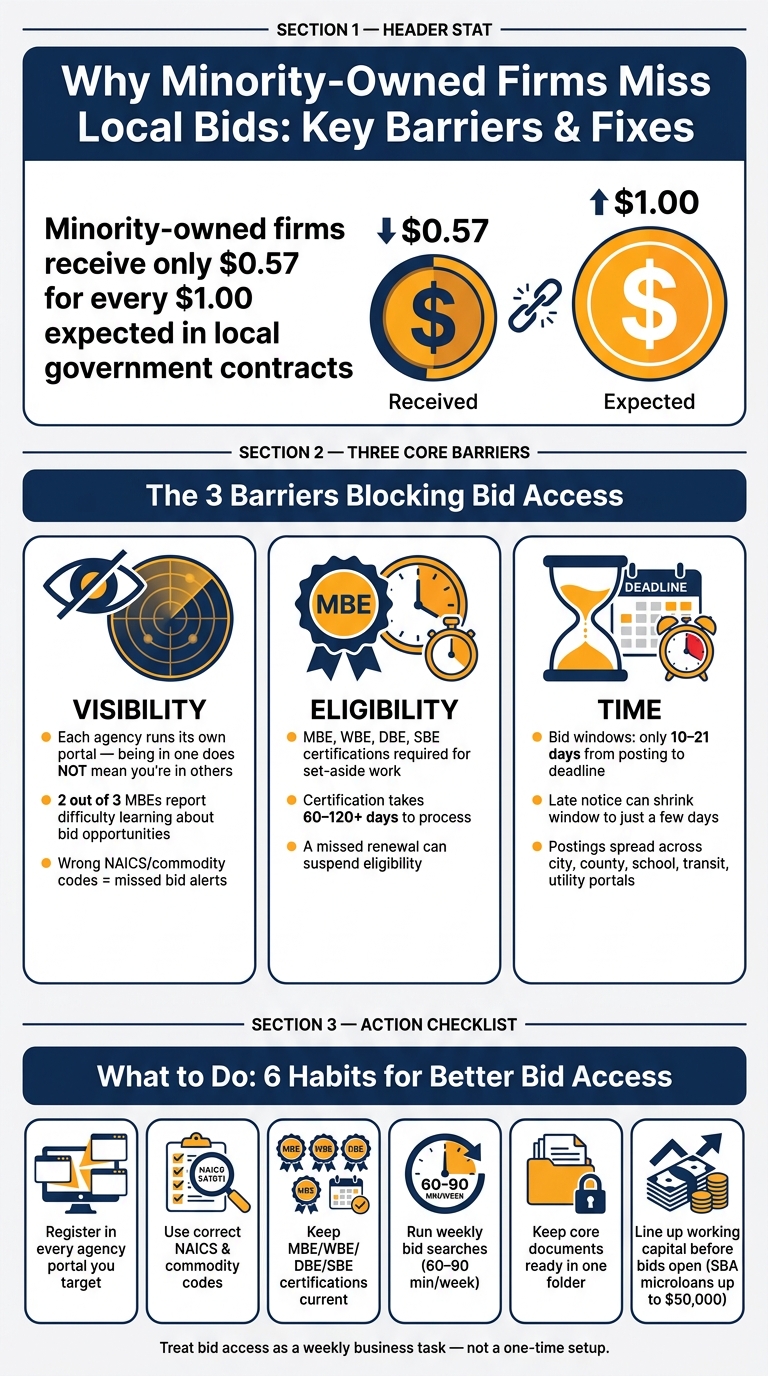
Why Minority-Owned Firms Miss Local Bids: Key Barriers & Fixes
How To Get Contracts With Your Local Government, Minority Certification & More! TNH WEBINAR
sbb-itb-1eb586e
The main barriers that block local bid access
Getting access to local contracts often starts well before a bid goes live. Agencies build vendor lists early and, in many cases, send notices only to firms already in their systems. On the ground, access usually comes down to three things: visibility, eligibility, and time.
Vendor registration gaps that block bid alerts
A lot of city, county, school district, and transit agency purchasing systems send bid notices only to vendors that are already registered in their portals. If a firm has missing NAICS codes, the wrong commodity categories, or old contact details, those bid alerts may never arrive.
There’s another snag: each city, county, school district, transit agency, and utility often runs its own portal. So being registered in one system does not mean a firm is registered anywhere else.
Missing certifications that limit eligibility
MBE, WBE, DBE, and SBE certifications shape who can go after many local contracts. Set-aside work is limited to certified firms, and bigger projects often require prime contractors to meet MBE/WBE subcontracting goals. On top of that, supplier diversity directories that agencies use to find vendors are also limited to certified businesses.
The timing here can be rough. Certification can take 60 to 120 days or longer, and a missed renewal can put eligibility on hold. Applications usually ask for tax returns, formation documents, proof of 51% minority ownership and control, and detailed narratives.
For a small firm, this can turn into a serious paperwork burden. If the owner is also handling sales, payroll, hiring, and client work, that admin gap can easily mean missing current set-aside opportunities.
Short deadlines and scattered bid postings
Even when a minority-owned firm is fully registered and certified, timing can still close the door. Local solicitations often allow only 10 to 21 days from posting to submission deadline. If the notice shows up late, that window may shrink to only a few days. That’s often not enough time to build pricing, pull bonding and insurance papers, line up subcontractors, and attend any required pre-bid meetings.
The postings themselves are scattered across city purchasing sites, county procurement systems, school district portals, transit agencies, utilities, and special districts, each with its own platform. It’s a lot to track. One Minnesota disparity study found that two-thirds of MBEs reported difficulty learning about bid opportunities with public entities, compared with about one-third of majority-owned firms.
For small teams, checking multiple portals every day just isn’t realistic. And when a posting is missed, the revenue is missed too.
Those delays hit small firms hardest because they already have limited staff, time, and cash.
Why these gaps hit small firms hardest
Finding a bid is only the first hurdle. Putting together a strong response is where many small firms get squeezed. It takes time, paperwork, cash, and enough staff to keep the whole thing moving. When notices show up late or key documents are missing, a possible bid can turn into a scramble.
Less time to put together a complete bid
Late notice shrinks the time for everything that comes next: reviewing specs, setting up site visits, getting quotes, checking insurance, and tracking addenda. The first cracks usually show up in the paperwork and the pricing.
The most common mistakes aren’t dramatic. They’re basic, but they still knock bids out: missing signatures, insurance limits that don’t match, addenda that weren’t acknowledged, or participation forms left blank. Those access issues don’t just slow a firm down. They can end in a rejected bid. And any one of them can get a bid thrown out, no matter how low the price is. When one owner is handling estimating, compliance, and the final submission, it’s easy for something small to slip past.
Pricing gets shaky too. Without solid quotes in hand, owners are left to estimate on the fly. That can mean bidding too low and getting stuck with cash-flow problems, or bidding too high and losing the job.
Added pressure on working capital and admin capacity
Pricing under pressure is only part of it. Cash flow is the other problem, and for many firms it’s the bigger one.
Winning local work often means spending money well before any payment comes in. A firm may need to cover labor, materials, equipment rentals, and permits before the first invoice is paid – often 30 to 60 days after work starts. For minority-owned small firms that already deal with higher borrowing costs and more credit denials, that gap can be hard to carry.
The strain can start even before the contract is signed. Bonds and higher insurance requirements are often needed upfront. With short deadlines, owners may not have enough time to get quotes from bonding agents or work out payment terms with suppliers. At that point, some make the only call they can: they skip the bid.
Early access to capital can change that math. An SBA microloan of up to $50,000 can help cover payroll, supplies, and equipment during the payment gap. For minority-owned firms and startups with limited or poor credit, SBA50K offers SBA microloan guidance, lender connections, and business plan support. With funding lined up early, firms have a better shot at moving when the right contract opens.
Steps to improve local bid access
Three habits can help you miss fewer bids: weekly searches, the right certifications, and funding lined up ahead of time. These are hands-on problems, so the fixes should be hands-on too.
Set up a weekly bid search routine
Set aside 60 to 90 minutes each week for bid searches. Check the portals you want to track, then run saved searches by NAICS or commodity code.
Start with registration. Then set up alerts and saved searches. Register under every NAICS code you actually perform. If you pick too few codes, you can miss bid alerts that fit your work. Send notifications to a shared inbox, such as [email protected], so they don’t disappear into one person’s email. It also helps to keep a simple spreadsheet with each portal’s web address, login details, and renewal dates.
Once this becomes part of your routine, the next move is to line up your certifications with the agencies that buy what you sell.
Get the certifications that matter in your local market
Go after the certifications that show up most often in local solicitations. Focus on the one used most in your area, especially DBE for transportation work and MBE/WBE for city and county projects.
Don’t try to get every certification at the same time. Pick one or two local priorities first. After that, build one digital folder with the documents you’ll keep using:
- tax returns
- ownership records
- articles of incorporation
- business licenses
- photo IDs for all owners
- organizational charts
- resumes
- financial statements
Certification agencies say missing paperwork is one of the main reasons applications slow down or get denied. If you keep that folder current and update it at least once a year, renewals and new applications tend to move with less friction.
With visibility and eligibility handled, the next issue is simple: can you do the work when the chance comes up?
Line up funding and proposal support before opportunities open
Labor, materials, and insurance can all come due before the first invoice gets paid. An SBA microloan of up to $50,000 can cover working capital, supplies, machinery, and equipment for eligible business needs. For firms with limited or poor credit, SBA50K offers a step-by-step funding guide, connects owners with SBA intermediary lenders, and provides custom-written SBA-approved business plan and loan application support to improve approval chances. Start early so your financing is in place when a bid shows up.
It also pays to plan proposal support ahead of time. That might come from a local Procurement Technical Assistance Center (PTAC), a Small Business Development Center (SBDC), or a paid consultant. If that relationship is already set before a bid drops, you won’t lose precious time getting help after the clock starts.
Conclusion: A short checklist for better bid access
Use this checklist to stay visible, eligible, and ready before local bids open.
These four habits help stop bid access from slipping through the cracks.
| Area | What to do |
|---|---|
| Vendor registration | Register in each city, county, school district, and state portal you pursue; track logins and renewal dates |
| Profile maintenance | Review profiles every quarter; keep NAICS codes, contact email, licenses, and ownership details current |
| Certifications | Track MBE, WBE, DBE, or local SBE deadlines by jurisdiction |
| Bid monitoring | Run weekly portal searches; route alerts to a shared inbox |
| Documents | Keep a ready folder with tax returns, insurance certificates, financial statements, a capability statement, and past performance |
| Funding | Identify working capital needs early; SBA50K helps eligible owners pursue SBA microloans up to $50,000 |
Treat this as a weekly operating list, not a one-time setup.
You don’t need a large team or a big budget to stay on top of this. A 60–90 minute weekly block can be enough to keep registrations active, check for new bids, and move paperwork along. When bid access becomes a regular business task – like bookkeeping or marketing – you’re far less likely to miss chances when agencies start looking.
FAQs
How do I know which local portals to register in?
Start with SBA resources. They can point you to local contracting portals and small business support programs that fit your situation.
Government sites like GovLoans can also help you find programs and platforms worth checking.
It also helps to look at groups like the National Women Business Owners Corporation and local Women’s Business Centers. They may help you find the right contracting networks and connect with potential clients.
Which certification should I get first?
First, make sure your business is properly registered with the local, state, and federal agencies that apply to you, including getting an EIN. Then focus on certifications that confirm your company’s status, such as minority-owned or small business designations.
These credentials often serve as the starting point for going after local bids. SBA50K also offers resources to help you get your paperwork in order and build a stronger base for your business.
How can I prepare for bid costs before award?
Keep your financial records in order before you spend money on bids. It also helps to map out how you’ll use your capital ahead of time. A professional, SBA-compliant business plan with a clear use of funds and realistic financial projections can make a strong case.
You should also have these basics ready:
- Your business registration
- Your EIN
- An active business bank account
If you’re short on capital, SBA50K can help you pursue SBA microloans of up to $50,000. That support can include guidance, business plan help, and connections to lenders.
Leave a Reply