
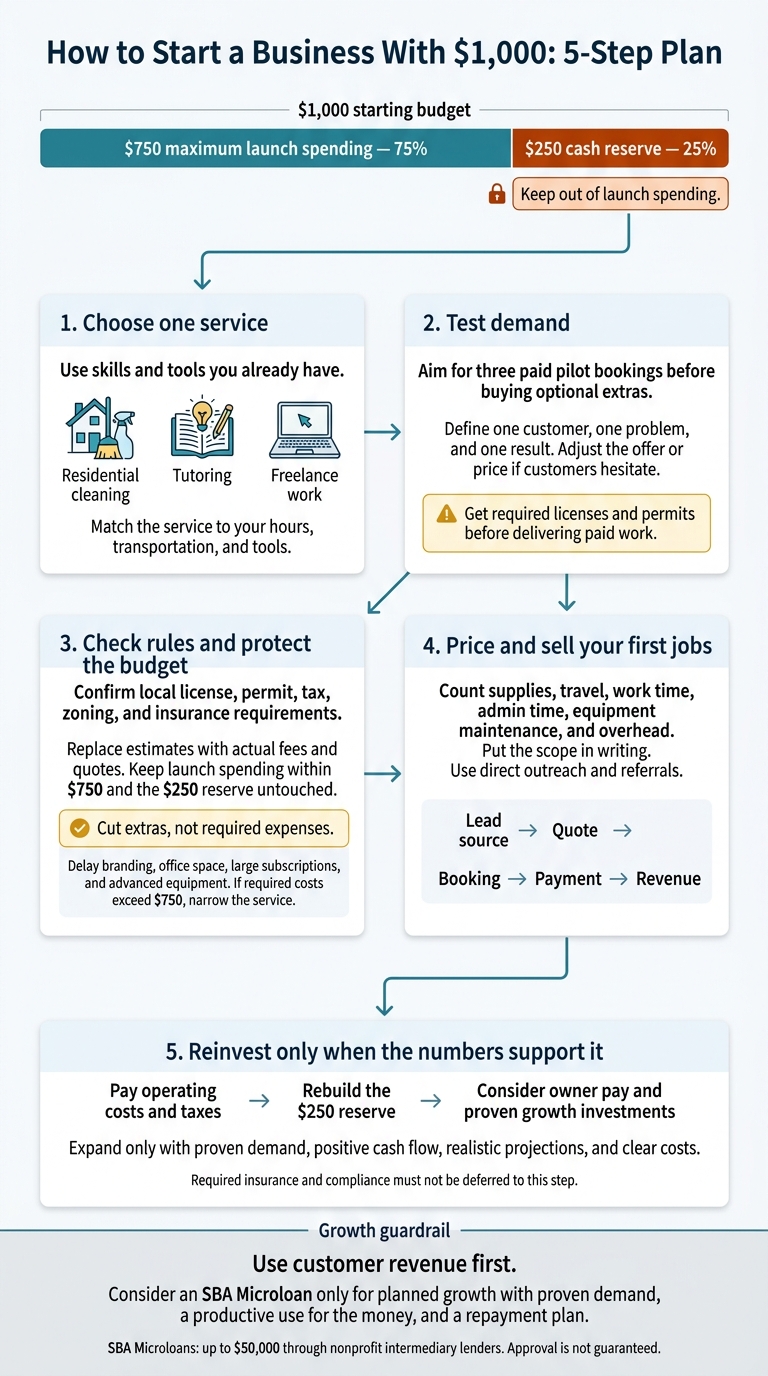
I’d start a business with $1,000 by selling a service I can deliver with skills and tools I already have. My spending limit: $750 to launch and $250 – 25% of the budget – held back as a cash reserve.
I’d compare residential cleaning, tutoring, and freelance work, then follow this plan:
- Test demand: Aim for three paid pilot bookings before buying optional extras.
- Check local rules: Confirm license, permit, tax, and insurance costs before delivering paid work.
- Price for profit: Count supplies, travel, work time, and admin time. Put the scope in writing.
- Find customers: Start with direct outreach and referrals, then track bookings and payments.
- Use revenue carefully: Pay costs and taxes, rebuild the reserve, and expand only when the numbers support it.
My rule: <u>cut extras, not required expenses</u>. I’d use customer revenue first and consider an SBA Microloan – up to $50,000 – only for planned growth with proven demand and a repayment plan.
How to Start a Business With $1,000: 5-Step Plan
1. Choose a Service and Check Demand
Compare Cleaning, Tutoring, and Freelance Work
Start with a service you can deliver reliably using what you already own. Match it to your available hours, transportation, and tools – not just how much it could earn. Compare the options below to see which requires the fewest purchases.
| Business type | Startup costs | What it takes | Pricing approach | Repeat business | Main risks |
|---|---|---|---|---|---|
| Residential cleaning | $400–$800: supplies, vacuum, insurance | Transportation, physical stamina | Hourly or flat fee | High: weekly or biweekly | Injury, property damage |
| Tutoring | $100–$300: background check, materials, marketing | Subject expertise, matching student schedules | Hourly | High: weekly | No-shows, seasonal demand |
| Freelance work | $300–$900: software, portfolio site, hardware upgrades | Digital skills, computer, internet | Per project or hourly | Moderate: project-based | Scope creep, nonpayment |
These are planning estimates, not quotes. Check what you need to buy; equipment you already own can lower costs. Local licensing, permit, and insurance requirements can also change the total.
Keep launch costs within your $750 budget, and check local compliance costs before choosing a service. Cleaning or freelance setups at the upper end of these ranges may leave too little for required expenses and a reserve. If the costs don’t fit, narrow your service or choose one that uses more of what you own. Don’t spend the reserve to close the gap.
Once an option fits your budget and skills, test it with potential customers before paying for extras.
Test One Offer With Potential Customers
Check whether people will pay for your service before buying anything optional.
Define one customer, one problem, and one result. Explain what your service includes and when you can deliver it. Check local competitors’ services and prices. Then ask potential customers what they need help with and what might stop them from booking. Record their answers – friendly encouragement isn’t proof of demand.
Aim for three paid pilot bookings before buying branding, advanced software, or specialized equipment. Get the required licenses and permits before delivering paid work. Finished jobs that customers have paid for tell you more than interest alone.
If people hesitate, change the service, price, or target customer and test again. If your price doesn’t cover your costs and time, adjust the service or choose another option before spending more.
sbb-itb-1eb586e
2. Plan Your $1,000 Budget and Check Local Rules
Budget $750 for Launch and $250 for a Reserve
Once you’ve tested one service offer, give every dollar a job. Treat your $1,000 as starting capital: set aside $250 and limit launch spending to $750. Replace estimates with actual fees and quotes before you buy anything.
| Category | Amount | Purpose | Essential or optional |
|---|---|---|---|
| Supplies or equipment | $250 | Cleaning kits, tutoring materials, or freelance software | Required essentials only |
| Registration or permits | $150 | State and city filing fees and local permits | Required where applicable |
| Insurance or compliance | $100 | General liability or professional liability insurance | Required where applicable |
| Basic online tools | $100 | Basic website hosting, domain, and scheduling tools | Optional |
| Marketing | $150 | Business cards, flyers, or initial social media ads | Optional |
| Emergency reserve | $250 | Emergency repairs, transportation, and payment fees | Untouched reserve |
| Total | $1,000 | Launch costs plus reserve |
These amounts are allowances, not guaranteed prices. Keep the reserve out of your launch spending so it’s available for operating costs. Wait until you know your required costs before spending on optional items.
Check Requirements and Delay Optional Spending
Before spending beyond essentials, check state, county, and city requirements for licenses, permits, taxes, zoning, and insurance. Ask the responsible agency to confirm each fee, renewal cost, and due date. That will tell you whether the $150 allowance covers the costs – or whether you need to cut optional spending.
SCORE or a Small Business Development Center (SBDC) can provide free counseling to review your numbers. Then verify requirements with the relevant agencies and request insurance quotes for your service. The $100 insurance allowance is a placeholder, not a coverage guarantee.
Start with resources you already have. Put off custom branding, office space, large subscriptions, and advanced equipment. Cut extras, not legal requirements. If required launch costs still exceed $750, scale back your service offer before launch and leave the $250 reserve untouched.
3. Set Prices and Find Your First Customers
Calculate Your Price and Define the Work
With your launch budget set, price each job to cover your actual costs without dipping into the $250 reserve. Charge for the whole job, not just your time on-site. Factor in supplies, equipment maintenance, and administrative overhead. Your price should fit your target customer, account for realistic demand, and leave room for profit.
Put the scope in writing. State what’s included, what’s excluded, and any limits on revisions, time, or deliverables.
For cleaning, list the rooms and tasks. For tutoring, specify the subject and session length. For freelance work, define deliverables and revision limits so the project has a clear finish line and doesn’t turn into extra unpaid work.
Get Customers Through Referrals and Outreach
Ask each satisfied client for one referral, and follow up with interested prospects by text, email, or phone. Use one spreadsheet to track each lead’s source, quote, booking, payment, and revenue.
Keep the outreach methods that bring in bookings. Your first bookings will help you see which messages and customer sources lead to the fastest sales.
Once revenue starts coming in, rebuild your reserve before buying anything beyond the basics or expanding.
4. Reinvest Revenue and Control Growth
Restore Your Reserve Before Expanding
After your first paid jobs, move from launch mode to cash management. Pay operating costs and taxes, then rebuild your $250 reserve before taking owner pay.
With that reserve in place, pay for required insurance. Next, put money into equipment or marketing that has already helped increase repeat sales or improve efficiency. Take on more work only when positive cash flow, realistic projections, and clear costs show you can afford it.
If growth requires more money than your cash flow provides, consider debt only after you’ve proven demand.
Consider SBA Microloans Only for Planned Growth
Use customer revenue first. Borrow for planned growth only after documenting demand, revenue, a specific productive use for the money, and a repayment plan. SBA Microloans offer up to $50,000 through nonprofit intermediary lenders for eligible small businesses.
Each lender sets its own documentation, collateral, credit, and loan-term requirements. Approval isn’t guaranteed.
Follow a 5-Step Launch Checklist
Use this checklist to keep your launch on track:
- Choose one service you can deliver with the skills and resources you already have.
- Test demand before spending your full budget.
- Check licenses, fees, and insurance, and keep launch spending within $750.
- Price and sell your first jobs at rates that cover costs and leave a profit.
- Reinvest only when demand, cash flow, and projections support more work.
9 Service Businesses You Can Start Under $1,000 (No Experience Needed)
FAQs
Do I need an LLC to start with $1,000?
No – you generally don’t need an LLC to start with $1,000. You can begin as a sole proprietor and form an LLC later if you want added liability protection and a more formal business structure.
If you apply for financing, lenders typically care more about accurate information on your legal structure, a clearly documented plan, and startup costs than whether you form an LLC right away.
How much should I set aside for taxes?
Budget for at least 3 to 6 months of operating costs, including applicable income taxes and payroll taxes if you have employees. Set aside the tax portion in a dedicated cash reserve within your working capital. That keeps money earmarked for taxes from going toward supplies or marketing.
Back up your startup budget with a simple cash-flow projection that shows when tax payments are due.
Should I require deposits from new customers?
You usually don’t need a deposit from every new customer, especially while you’re still testing demand. But when upfront costs or scheduling risks are high – such as with custom work or materials – a small deposit can help smooth cash flow.
Lenders care more about your cash reserves and ability to repay than whether you collect deposits. Keep your pricing and startup budget in line with realistic forecasts and the cash cushion you need to run your business.
Leave a Reply