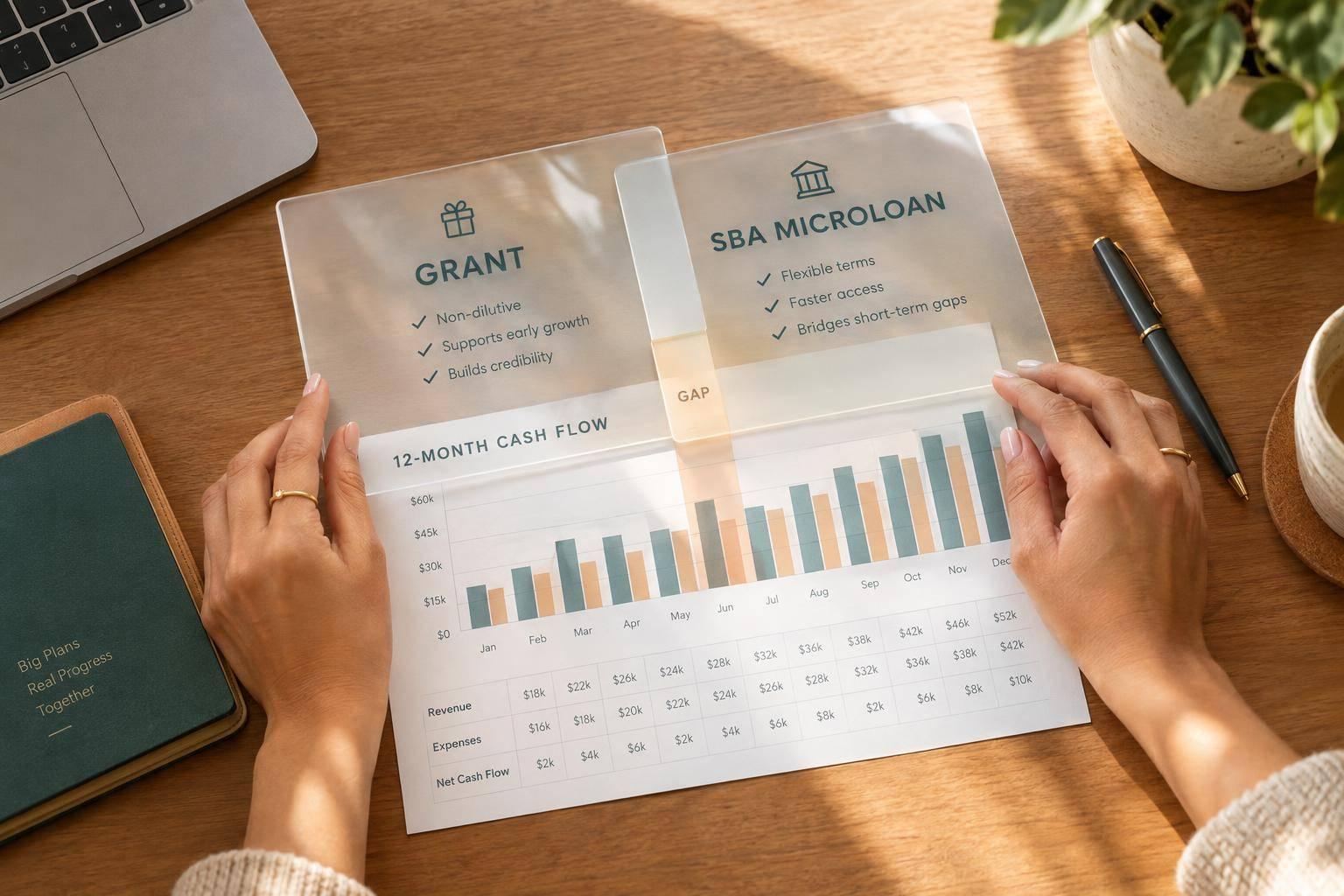
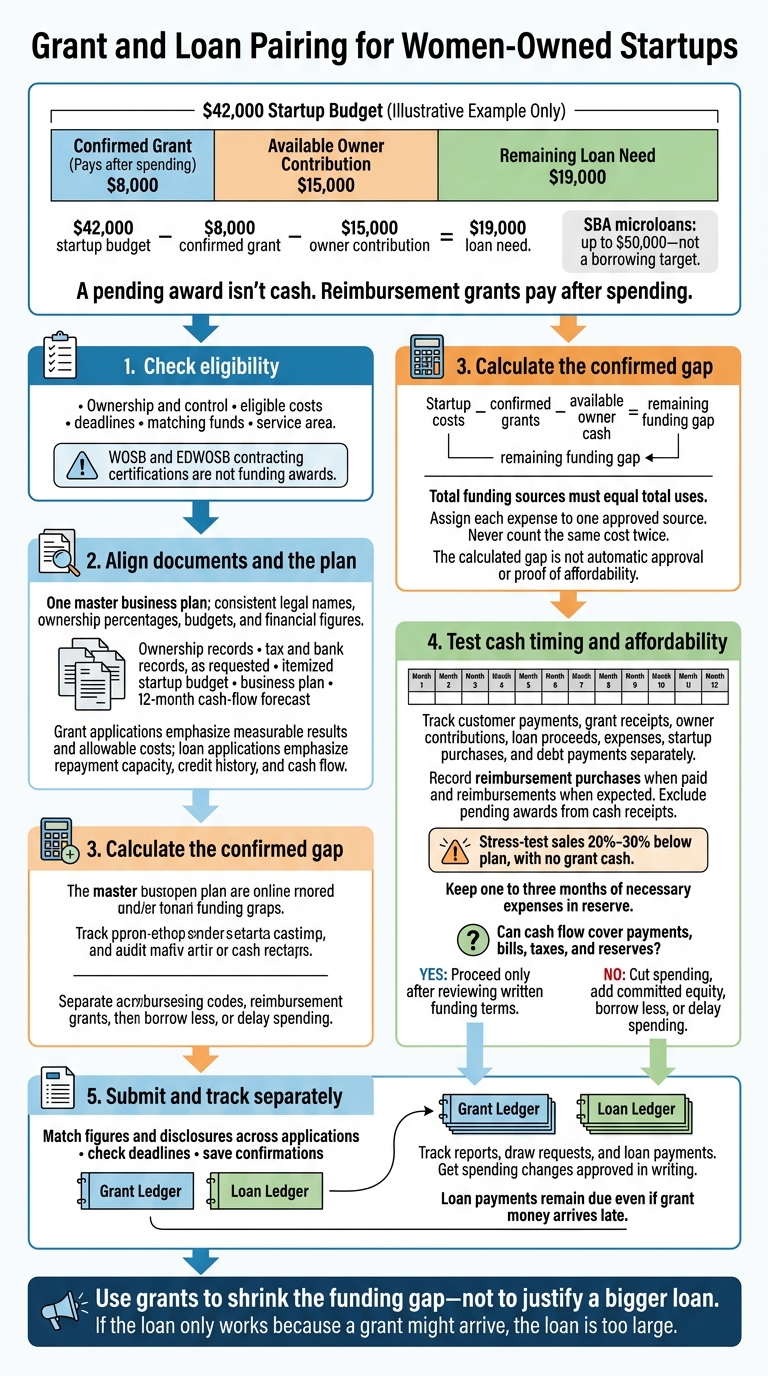
My rule for pairing grants and loans: borrow only what’s left after confirmed grants and available owner cash. For a $42,000 startup budget, an $8,000 grant and $15,000 owner contribution leave a $19,000 loan need – not a reason to borrow the full $50,000 available through SBA microloans.
Before applying, I’d check five things:
- Eligibility: Confirm ownership rules, allowed expenses, deadlines, and any required matching funds.
- Paperwork: Keep the budget, business plan, ownership records, and financial figures consistent.
- Cash timing: A reimbursement grant pays after spending. A pending award isn’t cash.
- Repayment: Build a 12-month cash-flow forecast and test sales 20%–30% below plan, with no grant cash.
- Compliance: Track each funding source separately, avoid billing the same expense twice, and get spending changes approved in writing.
<u>A grant can reduce borrowing, but it doesn’t remove repayment risk.</u> I’d accept a loan only when cash flow can cover payments, bills, taxes, and a reserve – even if grant money arrives late.
Grant and Loan Pairing for Women-Owned Startups
Check Eligibility and Prepare Documents
Start with the program rules: deadlines, eligible costs, matching funds, service area, and required documents. Review the grant administrator’s and intermediary lender’s current requirements, then record them on a one-page screening sheet.
Check Ownership and Program Rules
Check the required business structure, ownership percentage, control, and certification format. Some programs accept self-attestation; others require formal certification. WOSB and EDWOSB contracting certifications are not funding awards.
For an SBA microloan, confirm that your business meets requirements for U.S. operations, for-profit status, SBA size limits, industry eligibility, and the lender’s service area. Nonprofit child care centers are a limited exception. Check both programs to make sure your grant-loan pairing qualifies.
Grant eligibility may also depend on your location, industry, business stage, revenue, innovation, or community impact. The SBA generally does not offer grants to start or expand ordinary for-profit businesses. Specialized research programs and private grants have their own requirements.
Gather Credit and Application Records
| Ready | Record | Common grant purpose | Common loan purpose |
|---|---|---|---|
| ☐ | Government-issued identification and taxpayer information | Verify applicant and payee | Verify borrower and guarantors |
| ☐ | Formation documents, operating agreement, and ownership ledger | Establish qualifying ownership | Confirm borrower, control, and signing authority |
| ☐ | Licenses, permits, EIN, and state registrations | Establish lawful operation | Verify business registration and readiness to operate |
| ☐ | Personal and business tax returns, if available | Show financial history or need | Assess income and repayment capacity |
| ☐ | Recent business and personal bank statements, if requested | Verify cash and matching funds | Review deposits, expenses, and obligations |
| ☐ | Startup budget and itemized use-of-funds schedule | Support project costs | Support the loan request |
| ☐ | Business plan and 12-month cash-flow forecast | Show feasibility and intended results | Support repayment assumptions |
| ☐ | Award notices, commitments, or eligibility certifications requested by the program | Document eligibility and funding restrictions | Verify committed funding and restrictions |
Keep legal names, ownership percentages, and financial figures consistent across every document. If your startup has no business tax returns, explain why instead of leaving them out without a note.
Lenders review credit, debts, cash flow, and management experience. They may also ask about minimum credit history, owner contributions, collateral, and personal guarantees. A personal guarantee can make you personally responsible for repayment.
If your business has a short track record, support your application with relevant experience, documented investment, signed customer commitments, and conservative projections. Explain past credit problems honestly. Limited credit alone does not determine the outcome.
Your documents should support one clear budget and funding plan: the grant pays for approved costs, and the loan fills the remaining gap that your cash flow can repay.
Prepare for a Microloan With SBA50K
If you need help putting together your startup’s loan package, SBA50K offers step-by-step microloan guidance, lender connections, application help, and business-plan support for applicants with limited credit. The intermediary lender makes the credit decision. Before paying for support, check pricing, deliverables, refund terms, and lender requirements.
sbb-itb-1eb586e
Write a Business Plan for Grants and Loans
With eligibility confirmed and documents ready, build a business plan that lenders can review.
Start with one master plan, then tailor it for each application. Keep ownership details, budgets, and assumptions consistent across versions. Write the executive summary last, covering the problem, target customer, solution, ownership, current business stage, funding gap, and expected results.
Show how grant-funded results connect to loan-funded purchases that help the business repay its debt. Grant applications should emphasize measurable results and allowable costs. Loan applications should focus on repayment capacity, credit history, and cash flow. Back every claim with a document, quote, or forecast.
Back Your Business Plan With Evidence
Explain what you sell, who will buy it, how you’ll reach customers, and who will manage the work. Give reviewers a way to check each claim.
| Plan section | Evidence to attach or cite |
|---|---|
| Ownership and management | Founder résumés, management responsibilities |
| Products, services, and competitive position | Pricing sheets, product specifications, market research |
| Target market, marketing, and sales | Customer interviews, channel budgets, signed contracts |
| Operations and staffing | Vendor quotes, hiring timeline, payroll estimates |
| Funding request and financial projections | Itemized spending schedule, forecast assumptions, projected financial statements |
For signed contracts or purchase orders, record the customer, value, delivery date, payment terms, and cancellation conditions. Keep commitments separate from possible sales: treat signed contracts as commitments, and place letters of intent and uncommitted leads in a separate forecast section.
Then map each dollar to a specific expense and funding source.
Explain Spending and Loan Repayment
Create a use-of-funds schedule showing each expense’s amount, funding source, timing, quote, and milestone. Identify grant funds, loan proceeds, and available owner contributions. Total funding sources must equal total uses.
Grant expenses must be allowable, directly tied to the award, reasonably priced, and within the award period. Loan expenses must also meet the loan’s permitted uses.
Support your request with a month-by-month cash-flow forecast for 12 months, projected income statements, an opening balance sheet, and a debt schedule. Add a longer-term forecast when requested. Show how operating cash flow will cover repayments, how much cash you’ll hold in reserve, and which expenses you would delay if funding arrives late.
SBA50K helps organize these materials, draft the plan, and prepare women-owned startups for SBA microloans of up to $50,000.
Check Cash Flow and Loan Affordability
Use your business plan numbers to check whether the grant and loan will work together month by month.
Profit isn’t cash. You may record sales before customers pay, but payroll, rent, deposits, and equipment need cash now. Check whether you can pay bills and repay a loan sized to your funding gap – not the maximum amount offered.
Build a 12-Month Cash-Flow Forecast
Start with a base case that assumes no new funding. This shows when cash first runs short. Then add confirmed grant receipts, owner contributions, and loan proceeds as separate rows.
Use a column for each month, from 1 through 12, and carry each month’s ending cash into the next month. The forecast should show whether you can repay the loan after accounting for grant timing and startup costs.
| Monthly row | What to enter |
|---|---|
| Beginning cash | Previous month’s ending cash |
| Sales receipts | Customer payments, not invoices |
| Grant receipts | Cash expected under confirmed award terms |
| Owner contributions | Cash the owner actually deposits |
| Loan proceeds | Net cash received at closing |
| Operating expenses | Recurring payments for payroll, rent, supplies, insurance, and taxes |
| Startup purchases | Equipment, initial inventory, deposits, and other one-time payments |
| Principal, interest, and fees | Existing and proposed loan payments and fees |
| Ending cash | Beginning cash + receipts and financing − all payments |
For reimbursement grants, enter the eligible purchase when you pay for it and the reimbursement when you expect it. Check pre-award spending rules before buying. Label grants as cash received, pending, or reimbursement expected. Leave pending awards out of cash receipts, and track expected reimbursements separately.
Test Payments and Cash Reserves
Get the lender’s interest rate, fees, payment amount, maturity, and first payment date in writing. Include any variable-rate changes or deferred-payment terms.
Before submitting your application, run the same worksheet through the stress tests below. Record the lowest cash balance for each case.
Scenario Changes to test Payment and reserve check Expected Supported sales forecast, current expense quotes, confirmed grant timing Apply the lender’s payment schedule; compare the lowest cash balance with your reserve Conservative Sales 15%–25% below plan, collections 30 days later, grant one month late, costs 10% higher Keep debt payments on schedule; find the first month cash falls below your reserve Downside Sales 30%–40% below plan, seasonal weakness, grant unavailable, unexpected repair or inventory cost, no additional owner contribution Identify any missed payment or negative balance; reduce borrowing or spending before accepting debt
Calculate break-even sales as fixed monthly costs ÷ contribution-margin percentage. To estimate the sales needed to cover cash outflow, add monthly debt service, taxes, necessary owner pay, and inventory replenishment not already counted to the numerator.
Keep one to three months of necessary expenses in reserve. If the downside case drops below that floor, cut spending, add committed equity, or borrow less. Check the lender’s debt-service coverage ratio threshold, especially in the conservative and downside cases.
Include this forecast in your application packet and keep it aligned with bank statements.
Submit Applications and Meet Funding Rules
Use the confirmed funding gap and cash-flow forecast to finalize each funding source and application amount. Grants and loans are separate sources. Assign each expense to one approved source, and never count the same cost twice.
Review Figures, Documents, and Funding Amounts
Check the final program instructions for last-minute changes before submitting. Make sure the legal name, EIN, ownership percentages, revenue, debt, and requested amount match across all documents. Replace generic claims with business-specific evidence, measurable targets, and documented costs. Check that budgets, required attachments, and signatures are complete and that you can meet submission deadlines.
Provide complete, truthful disclosures of debt, guarantees, other applications, and funding wherever requested. For credit problems, explain the date, cause, current status, and corrective action. Label funding as pending, conditionally approved, awarded but not disbursed, or received. Tell the relevant funder promptly about major changes and ask whether you need to amend any documents.
Plan Submission Timing and Track Obligations
Start by checking the rules and assigning costs to permitted sources. Then finish the plan and projections and gather supporting records. This is a critical step when applying for the SBA microloan program. Include measurable outcomes, deadlines, and evidence sources in grant requests. Update the loan request as awards are confirmed.
Time submissions around deadlines and cash needs. Don’t assume grant funds will arrive before the loan closes. Save submission confirmations, and add loan closing requirements, draw requests, reports, and payments to your calendar.
Once the documents agree, track each grant and loan separately by source, deadline, and reporting duty.
| Requirement | Grant | Loan |
|---|---|---|
| Spending | Approved activities, categories, and award period | Uses permitted by the loan agreement |
| Reporting | May require progress, financial, and final reports; late reports can delay funding. | Financial information and compliance updates required by the lender |
| Record retention | Keep award terms, receipts, payroll, match records, and outcome evidence for the required period | Keep loan documents, spending evidence, payment records, and collateral records for the required period |
| Repayment | No repayment if terms are met; unsupported costs may need to be returned | Principal, interest, and applicable fees remain due even if sales disappoint |
| Misuse consequences | Withheld funds, repayment, termination, or lost eligibility | Default, collection, collateral enforcement, and possible credit damage |
After submitting, use separate accounting codes for the grant and loan. Maintain an audit trail of invoices, payment dates, eligible categories, and current balances. Confirm whether borrowed funds, owner contributions, or another award can satisfy a required match.
Check approval requirements before changing purchases, vendors, budget categories, project schedules, or matching funds. Submit change requests in writing, explain the cost and project impacts, and keep written approval.
Conclusion: Borrow Only for the Confirmed Gap
Once eligibility, budgets, and cash flow are set, borrow only what’s still needed after confirmed grant funds and available owner cash. Use grants to shrink the funding gap – not to justify a bigger loan.
Before signing, check that figures, ownership details, and funding sources match across your grant and loan files. Assign each cost to just one funding source, and get grant rules and loan terms in writing.
Use those same figures to test affordability. Stress-test your 12-month forecast with sales 20%–30% lower and no grant cash. If loan payments leave too little for basic bills, taxes, and reserves, borrow less or delay spending.
SBA50K can help organize documents and draft the business plan, but it doesn’t guarantee approval.
If the loan only works because a grant might arrive, the loan is too large.
FAQs
Can I use a grant to pay off my startup loan?
No. Grants generally cover specific project costs or budget items approved by the grantor – not loan repayment. Using funds outside those approved purposes can lead to lost funding, legal action, and disqualification from future government funding.
Use the grant for approved project expenses and the microloan for its designated needs, such as working capital, inventory, or equipment. SBA microloan funds cannot be used to pay off existing debt.
Will receiving a grant affect my loan approval?
Receiving a grant doesn’t hurt your chances of loan approval. You can use a grant alongside an SBA microloan to cover different business needs, but you’ll need to apply for each separately.
A grant can lower the amount you need to borrow. Lenders will still review your creditworthiness, business plan, and ability to repay the loan.
What if my grant is canceled after my loan closes?
You’re still responsible for repaying your SBA microloan under its original terms. Grants are competitive and aren’t guaranteed, so treat them as extra funding – not money your business depends on.
Keep a 12-month cash flow projection that includes loan payments as a fixed expense. Set aside a reserve for unexpected costs, too. This plan can help you stay on top of payments and avoid default if the grant doesn’t come through.
Leave a Reply