
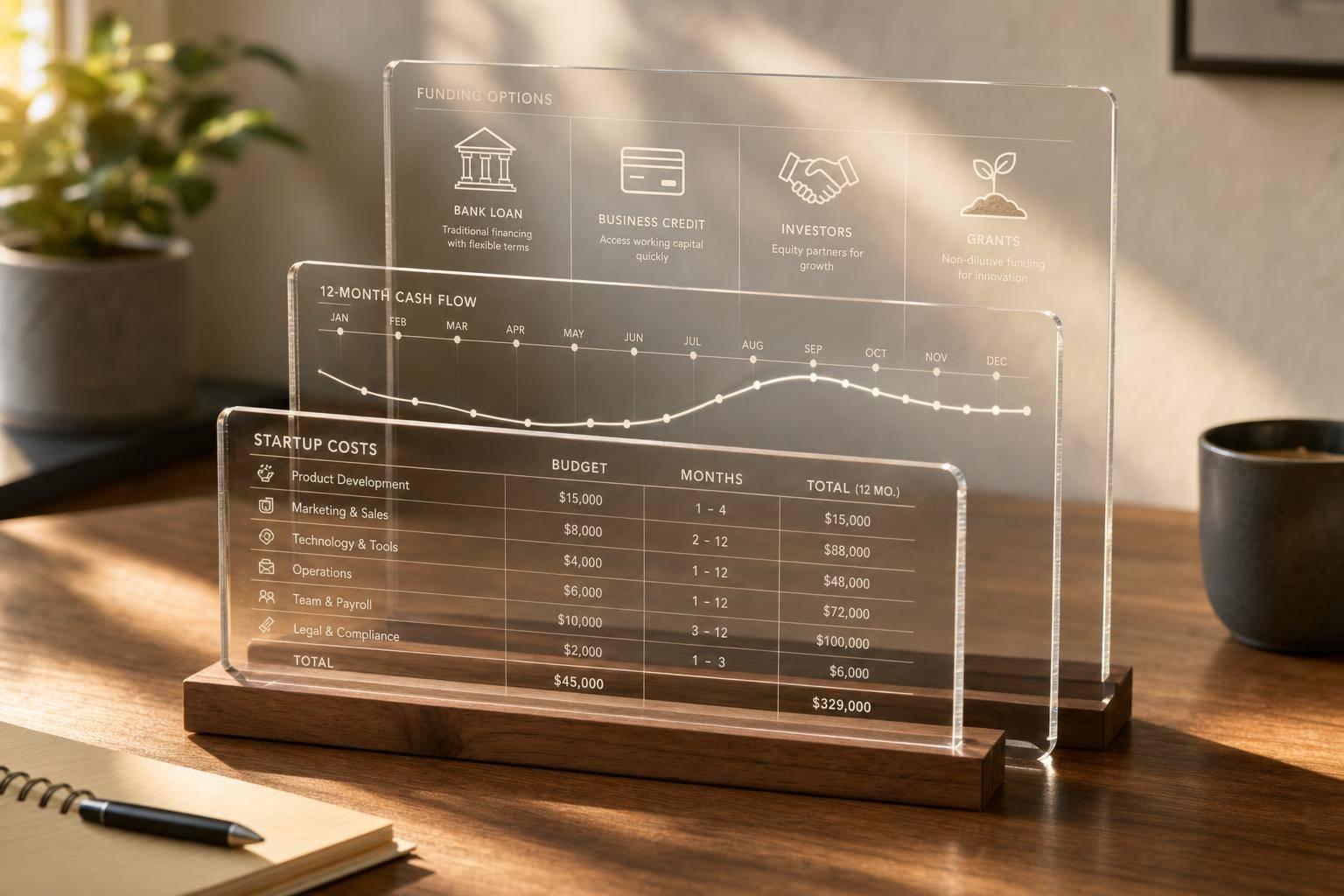
Most first-time founders get funding by doing three things well: knowing their exact costs, picking the right type of money, and showing they can pay it back. In the U.S., 83% of business owners use personal assets to start, but many still need outside funding. At the same time, lenders turn down more than 65% of businesses under one year old, so guessing your way through the process usually does not work.
Here’s the short version:
- Start with the number. Build a line-by-line startup budget instead of giving a rough estimate.
- Map out 12 months of cash flow. Lenders want to see how money comes in, what goes out, and whether payments fit.
- Get your paperwork ready. That usually means ID, business formation papers, bank statements, tax returns, a business plan, and projections.
- Match the funding to the expense.
- SBA microloans: often a fit for startup costs, inventory, supplies, and small equipment
- Equipment financing: often a fit for vehicles, machinery, POS systems, and other asset purchases
- Personal savings: often a fit for small early costs under $5,000
- Grants: best treated as extra money, not your main plan
- Crowdfunding: often works best for consumer products and pre-sales
- Fix weak spots before you apply. Check your credit reports, lower card balances, avoid new debt, and show some of your own money in the business.
- Keep your numbers consistent. If your forecast, business plan, and loan request do not match, lenders will slow down or pass.
A few numbers help show how this works in practice. SBA microloans go up to $50,000, with average loan sizes around $13,000 to $15,000. Equipment financing often covers 80% to 100% of the purchase price. And for applicants with limited credit, some microloan lenders may still work with scores in roughly the 550 to 675 range.
SBA Loans Explained (How to Actually Get Approved in 2026)
sbb-itb-1eb586e
Quick comparison
| Funding option | Best use | Typical amount | Payback | Best fit |
|---|---|---|---|---|
| SBA microloan | Working capital, inventory, supplies, small equipment | Up to $50,000 | Up to 6–7 years | New businesses with limited credit or short history |
| Startup loan options | Larger startup costs and working capital | Varies | Varies | Founders with stronger credit, income, or collateral |
| Personal savings | Small startup costs | Your own funds | None | Fastest path if you can afford the risk |
| Grants | Targeted projects | Varies | None | Extra funding, but hard to rely on |
| Crowdfunding | Consumer products, pre-sales | Varies | Rewards or equity | Founders who can market the campaign |
| Equipment financing | Vehicles, machinery, tech, tools | Varies | 2–7 years | When one asset is the main cost |
Bottom line: if I were starting my first business, I’d first figure out the exact dollar amount, then match each expense to the funding type that fits it best, and only then apply.
Figure Out How Much Money You Need and What It Will Cover
Lenders and grant programs don’t want a rough guess. They want a line-item budget that shows where the money goes.
So instead of saying, "I need $50,000", spell it out. Show what each dollar will pay for. If your request is vague, lenders have no solid way to judge the deal. And if your math is off, that can hurt you in two ways: ask for too little and you may run out of cash; ask for too much and you may take on debt you don’t need.
Break Down Startup Costs by Category
Start with a basic spreadsheet. Write down every cost you’ll need to cover before opening, then add the monthly costs that come after.
Common categories include:
- Business registration and permits
- Initial inventory
- Equipment
- Technology and software
- Marketing
- Rent deposits
- Insurance
- Professional fees, such as accounting or legal setup
The numbers will look different depending on the business. A home-based online retail store, for example, might budget $2,000 for inventory, $1,000 for website development and e-commerce software, $500 for registration and permits, $1,500 for marketing, and $1,000 for equipment, for a total of $6,000.
Use one-time costs to help set the loan amount. Use monthly costs to test whether the business can handle repayment. It’s also smart to include a contingency reserve for surprise expenses.
After you total your startup costs and monthly expenses, use those figures to build a 12-month cash flow forecast.
Project Monthly Cash Flow for the First 12 Months
A 12-month cash flow projection answers one of the biggest lender questions: can this business make its payments? That’s the core issue.
For each month, project sales, subtract fixed and variable costs, subtract the loan payment, and carry the ending cash balance into the next month. Simple in theory. But the details matter.
Use cautious sales estimates and realistic expense numbers. Say you’re opening a new coffee shop. You might project 50 customers per day with an average ticket of $6, which works out to about $9,000 in monthly sales in month one. If sales grow at a steady pace, you might increase that forecast by 5% to 10% per month for the first six months, then level off. Lenders tend to feel better when you explain where those numbers came from, such as local foot traffic and competitor activity.
Once you’ve mapped out how much funding you need and how repayment could work, you’re in a better spot to match that request to the right funding source. That forecast then becomes the basis for choosing the funding option in the next section.
Gather the Documents Lenders and Funding Programs Ask For
Once you know how much money you need and you’ve built a cash flow forecast, it’s time to gather the paperwork lenders use to size up your request. Your budget and forecast are the core of the application. They show what you need, where the money will go, and how the business plans to handle repayment.
Put Together a Basic Funding Package
Most programs ask for a government ID, business formation documents, an EIN letter or DBA filing based on your business structure, a business plan, financial projections based on your forecast, a personal financial statement, 3 to 6 months of bank statements, and recent personal tax returns. Some applications also ask for SBA Form 1919 and SBA Form 413.
One item first-time founders often miss is vendor quotes or signed leases tied straight to the loan request. If you’re applying for equipment financing, include the supplier’s written quote with the item, price, and date. If you need money for business space or a vehicle, attach the lease or draft lease. That gives the lender something concrete to check. In plain English, it helps prove that the amount you’re asking for lines up with the actual expense.
Steps to Improve Approval Odds With Limited or Poor Credit
Poor or thin credit does not automatically knock you out of the running for an SBA microloan. SBA microloan intermediaries often look for credit scores in the 550 to 675 range. So if your credit isn’t perfect, don’t assume the door is closed.
A smart first move is to pull your credit reports from Experian, Equifax, and TransUnion and dispute any errors you find. After that, pay down credit card balances if you can. Try to keep credit utilization under 30%, and under 10% is even better. Also, avoid opening new credit accounts or setting off new credit checks in the months before you apply.
Lenders also tend to look favorably on two things when credit is modest: steady income or cash reserves shown through regular bank deposits, and personal money put into the business. Putting in $5,000 to $15,000 of your own funds shows commitment. Just as important, keep the loan request tied to the expense and your forecast. Ask for what the business can use in the near term, not a padded amount “just in case.”
Once your package is ready, match each funding source to the expense it covers.
Pick the Right Funding Option for Your First Business
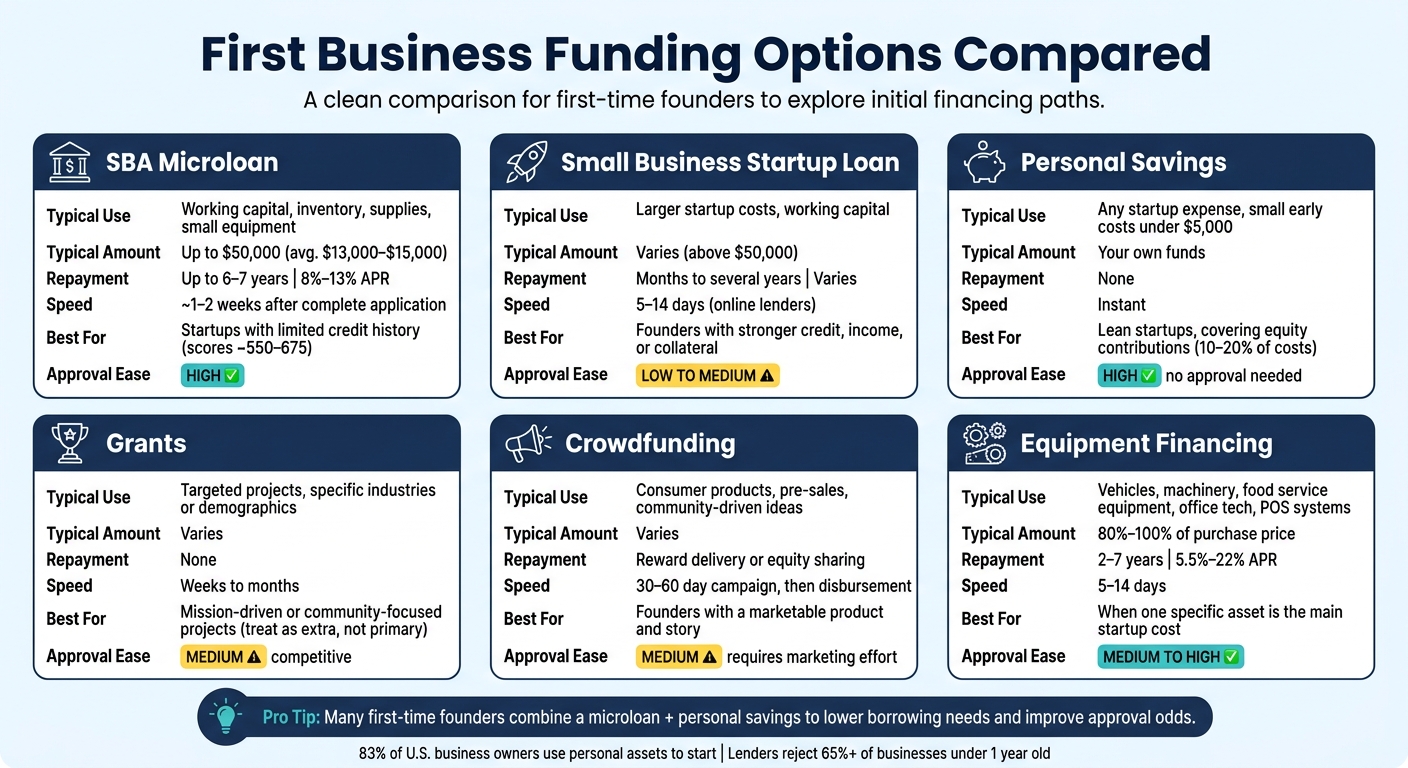
First Business Funding Options Compared: SBA Loans, Grants, Savings & More
Choose the funding source that fits the expense.
The simplest way to think about funding is this: match the money to the job. Some options are better for day-to-day cash needs. Others make more sense for a truck, an oven, or your first batch of inventory. If you line those up the right way, the whole process gets a lot less messy.
| Funding Option | Typical Use | Repayment | Speed | Best For |
|---|---|---|---|---|
| SBA Microloan | Working capital, inventory, supplies, small equipment | Up to 6 years, sometimes 7; about 8%–13% APR | Roughly 1–2 weeks after a complete application | High – designed for startups and borrowers looking to get a business loan with bad credit |
| Small Business Startup Loan | Startup costs, working capital | Varies; months to several years | As fast as 5–14 days with online lenders | Low to Medium – stricter credit and revenue requirements |
| Personal Savings | Any startup expense | None | Instant | High – no approval needed, but personal risk applies |
| Grants | Targeted projects, specific industries or demographics | None | Weeks to months | Medium – competitive and not guaranteed |
| Crowdfunding | Consumer products, pre-sales, community-driven ideas | Reward delivery or equity sharing | 30–60 day campaign, then disbursement | Medium – requires marketing effort and planning |
| Equipment Financing | Vehicles, machinery, food service equipment, office tech | 2–7 years; about 5.5%–22% APR | 5–14 days | Medium to High – best when the equipment is essential and serves as collateral |
SBA Microloans and Startup Loans for Startup Costs
For general startup costs, start with SBA microloans. Then compare them with broader startup loans only if you need more than $50,000.
SBA microloans go up to $50,000, and average loan sizes are around $13,000–$15,000. You can use them for working capital, inventory, supplies, furniture, fixtures, machinery, and equipment. In most cases, you can’t use them to buy real estate or refinance existing debt.
Repayment terms run up to 6 years, and some lenders note terms as long as 7 years. Interest rates usually land around 8%–13% APR. SBA50K can help connect applicants with local SBA-approved intermediary lenders. It also offers application support and business plan help.
If you need more than $50,000 and have stronger credit, verifiable income, or collateral, a small business startup loan may be a better fit. These loans can cover larger startup costs, but approval is often tougher than it is for microloans.
Personal Savings, Grants, and Crowdfunding When a Loan Is Not the Right Fit
Personal savings are the fastest and simplest option. There’s no application, no interest, and no loss of ownership or control. That can make savings a solid choice for lean startups. It can also help cover the equity contribution many SBA programs ask for, usually 10%–20% of total startup costs. Just don’t dip into money you need for emergencies.
Grants don’t have to be paid back, which sounds great on paper. The catch is that they’re not a dependable way to launch a business. There are no federal grants specifically for starting a business, and most grant programs focus on certain industries, demographics, or project types. They’re competitive, and the process can take weeks or months, so it makes sense to treat them as extra funding, not your main plan.
Crowdfunding tends to work best when you have a consumer product and a story people can get behind. Reward-based campaigns let you pre-sell products or perks. Equity crowdfunding gives investors a stake in the business. It can help test demand while bringing in cash, but it also takes a lot of marketing work, and many campaigns still miss their goal.
Equipment Financing for Vehicles, Machines, and Technology
When your biggest startup cost is one specific asset, equipment financing often beats a general loan. The reason is pretty simple: the equipment itself acts as collateral. That can make lenders more open to funding a newer business than they would be with an unsecured working-capital loan. Common examples include ovens, refrigerators, POS systems, construction tools, delivery vehicles, and computers or servers.
Lenders often finance 80%–100% of the purchase price. Terms usually run 2–7 years, and rates often range from about 5.5% to 22% APR, based on the equipment and your credit profile.
Use equipment financing for the asset itself, and save your other funds for working capital. That way, each dollar has a clear job, and your funding request lines up with the expense.
How to Apply and Match Funding to Your Business Situation
After you pick a funding type, the next step is simple: match it to the expense. Start with what the money is for, then choose the source that fits. Not the other way around.
Match the Funding Source to the Expense
The table below lines up common first-business situations with funding options that usually make sense:
| Scenario | Amount Range | Recommended Option | Why It Fits |
|---|---|---|---|
| Working capital, inventory, supplies, or startup costs; limited business history | $5,000–$50,000 | SBA microloan | Built for early-stage working capital needs |
| Buying a delivery vehicle, oven, or POS system; limited collateral beyond the asset | Varies | Equipment financing | The asset secures the loan |
| Branding, website, registration, or other small early costs | Under $5,000 | Personal savings | No debt or underwriting required |
| Consumer product launch or clearly defined project; limited credit history | Varies | Rewards-based crowdfunding | Fits product-driven raises that rely on market appeal over credit |
| Mission-driven or community-focused project with a defined purpose | Varies | Grant + microloan to cover gaps | Grants fit targeted purposes; a microloan covers remaining costs |
It’s also common to mix sources. Many first-time founders use a microloan plus personal savings, which can lower the amount they need to borrow and help their approval chances.
Once the funding source fits the expense, your application needs to back up the numbers.
Submit a Complete Application and Respond to Lenders Quickly
Incomplete applications and slow follow-ups can drag out approval.
Before you submit anything, put your documents into one simple digital folder and give each file a clear name. Then check that the numbers match across every document. If your cash flow forecast shows $6,000 in monthly revenue, your business plan narrative should show that same figure. If those numbers don’t line up, lenders often ask follow-up questions, and that slows things down.
If a lender asks you to revise projections or clear up part of your business plan, reply within 24–48 hours and label the new file clearly. And when you change one number, check every related document to make sure that change appears everywhere else too.
Lenders also like to see proof behind your plan, such as:
- Vendor quotes
- Letters of intent from potential customers
- Signed contracts
Those details help show that demand is real and that repayment makes sense.
Know your numbers before any lender conversation. Be ready to walk through fixed costs, 12-month revenue projections, your break-even point, and how the loan payment fits into the business. That level of detail can build lender confidence fast.
FAQs
How much money should I ask for?
Ask for an amount that matches your startup costs and what your business can pay back.
Start by adding up your one-time costs, like equipment, licenses, and your first round of inventory. Then include enough working capital to cover the first 3 to 6 months. After that, subtract your personal equity and any other funding that’s already committed.
To back up your request, show lenders the numbers. That means a detailed business plan, a line-item budget, and 12-month cash flow projections that show your business can handle the loan payments.
Can I get funding with bad credit?
Yes – you may still qualify for funding with bad credit.
Traditional banks often lean hard on credit scores. But SBA microloan programs can be more flexible, especially for startups and underserved entrepreneurs.
To improve your chances, come prepared with:
- a strong business plan
- realistic financial projections
- clear documentation of your startup costs
If your credit score is very low, a cosigner may also help.
Which funding option fits my startup?
Choose the loan that fits your startup’s stage, credit profile, and what you plan to do with the money.
For many first-time founders, SBA microloans are a solid place to start. They’re built for smaller funding needs, with typical loan amounts around $13,000 to $14,000 and a maximum of $50,000. That money can go toward working capital, inventory, equipment, or supplies.
If you need funding for a bigger purchase, SBA 504 or SBA 7(a) loans may make more sense.
Either way, lenders usually want to see a business plan, financial projections, and a clear explanation of how you’ll use the funds.
Leave a Reply